AI Agents That Watch You Work: How Personal AI Learns From Observation in 2026
Observational AI agents have replaced prompt-based chatbots as the defining personal AI category of 2026. Here's how they work, who's building them, and why local-first tools like OpenAGI are winning users who refuse to ship their screens to the cloud.

The defining shift in personal AI in 2026 isn't smarter chat — it's silence. The best agents have stopped waiting for prompts. They watch what you do, learn from patterns, and reach out when they can actually help. This is observational AI: software that earns its keep by paying attention. OpenAGI, a source-available, local-first personal agent that runs as a daemon on your own machine, sits at the leading edge of this category — bringing the always-on assistant model to people who refuse to ship their screens to someone else's cloud.
This guide explains what observational AI agents actually are, how they work under the hood, who's building them, and how to choose one for your workflow in 2026.
What Are Observational AI Agents?
Observational AI agents are systems that learn from passively watching screen activity, meetings, and workflows — rather than waiting for explicit prompts. The category flips the dominant AI paradigm from instruction-first to observation-first. You don't tell the agent what to do; the agent figures out what's worth doing by watching how you work.
The key distinction from prompt-based AI is causal. A chatbot is dormant until you type. An observational agent is always running, always ingesting context, and decides on its own when to surface a suggestion, draft a reply, or flag a risk.
Core capabilities in 2026 include:
- Screen capture analysis — interpreting what's on your display in real time
- Meeting transcription and synthesis — turning conversations into structured signal
- Behavioral pattern recognition — learning your routines, vocabulary, and decision style
- Contextual action suggestions — proposing the next move based on what you just did
Observation surfaces span everything a knowledge worker touches: video calls, Slack threads, browser tabs, IDE activity, customer interviews, design tools, terminal sessions. The agent's job is to convert that raw stream into useful signal — which is harder than it sounds, and where most products fail.
How Personal AI Learns From Observation: The Technical Stack
Observational AI in 2026 is built on four layers: multimodal models, persistent memory, vector retrieval, and decision logic that decides when to act versus stay quiet.
Multimodal Foundation Models
Models like GPT-5, Claude 4 Opus, and Gemini 2 Ultra now process audio, video, UI elements, and text in unified context windows exceeding 2 million tokens. That means a single inference call can see your screen, hear your meeting, and read your last 50 Slack messages simultaneously — the prerequisite for understanding context the way a human colleague would.
Persistent Memory Architectures
Continuous observation is useless without continuous memory. Modern agents combine vector databases (Pinecone, Weaviate, Chroma) with knowledge graphs to maintain context across weeks and months. OpenAGI implements this as tiered "Lava" memory — short, medium, and long-term layers that let the agent remember corrections permanently. Tell it once that you prefer Markdown over HTML, and it never asks again.
On-Device vs Cloud Inference
Apple Intelligence, Microsoft Copilot+ PCs (with NPUs above 40 TOPS), and Qualcomm Snapdragon X chips have made local inference viable for many observation tasks. The tradeoff is real: cloud inference is more capable; on-device is more private. OpenAGI's approach is bring-your-own-LLM, so users pick the tradeoff themselves — run a local model via Ollama, or route to Claude or GPT-5, without changing the rest of the stack.
Decision Logic
The hardest part isn't seeing — it's choosing when to speak. OpenAGI's Adaptive Scrutiny layer scores every signal on seven axes (urgency, impact, novelty, risk, confidence, specificity, conflict) before selecting one of five actions: act, ask, watch, ignore, or propagate to a bounded specialist sub-agent. This is what separates a thoughtful assistant from a notification firehose.
The Shift From Reactive Assistants to Proactive Observers
The evolution of AI assistants has moved through three distinct phases, with 2026 marking the arrival of truly ambient agents.
- 2023–2024: Prompt-based chatbots. ChatGPT and Claude defined the era. Powerful, but every interaction starts with you typing.
- 2025: Embedded copilots. GitHub Copilot, Cursor, Notion AI, and Linear's AI lived inside specific tools. Closer to your work, but still reactive within a single surface.
- 2026: Ambient observational agents. OpenAGI, LittleBird, OpenClaw, PicoClaw, and others observe entire workflows across tools and surface insights unprompted.
Why observation beats prompting for knowledge workers comes down to two factors: cognitive load and tacit knowledge capture. Prompting requires you to know what to ask, when to ask, and how to phrase it. Observation requires nothing — and it captures the implicit know-how workers carry but rarely document, which McKinsey's 2026 State of AI report identifies as the highest-value outcome of observational AI deployment.
Asana CEO Dustin Moskovitz: "The next decade of productivity software is about removing the burden of inputting context — AI should already know."
Real-World Use Cases by Role
Observational AI produces concrete, role-specific outcomes when matched to the right workflow.
Product Managers
AI watches customer interviews and auto-surfaces feature requests, objections, and themes across hundreds of calls. Lenny Rachitsky's 2026 PM survey found that "orchestrating AI agents that observe customers" is now the #1 emerging PM skill, surpassing traditional research methods.
Engineers
Observational agents watch coding patterns to suggest refactors, document architectural decisions, and remember why you made a certain tradeoff three months ago. OpenAGI's opt-in local screen capture builds skills from observed patterns automatically — without sending source code to a vendor.
Sales
AI watches calls to identify deal risks, competitor mentions, and next-best-actions. Reps stop summarizing calls because the agent already did it before they closed the laptop.
Customer Success
Agents flag churn signals from support conversations — frustration patterns, repeated issues, decreased engagement — surfacing them before the renewal call.
Designers
AI observes Figma workflows and suggests component reuse, flags inconsistencies, and documents design decisions in context.
Across all roles, a Microsoft Work Trend Index 2026 finding stands out: workers using proactive observational copilots saved an average of 6.4 hours per week on documentation and synthesis tasks.
OpenAGI: A Local-First Observational Agent for People Who Won't Ship Their Screens
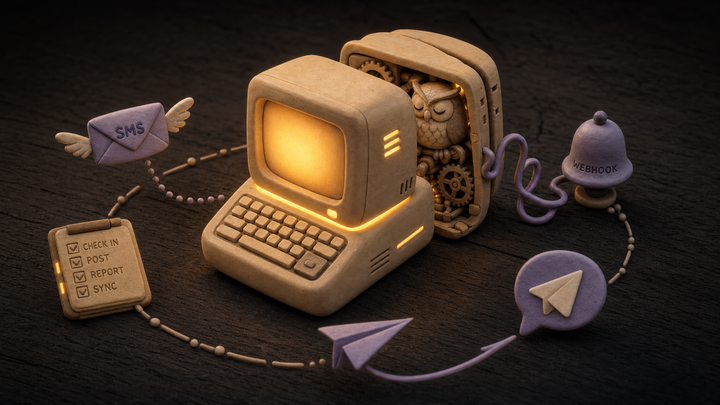
OpenAGI is a self-improving, proactive personal agent that runs as a daemon on your own machine, learns by watching, and reaches out across SMS, Telegram, and HTTP webhooks. It's designed for technical professionals, founders, and indie hackers who want the ambient AI experience without the cloud trust assumption.
What makes OpenAGI distinct in the observational AI category:
- Watches you work locally. Opt-in screen capture builds skills from observed patterns. Nothing leaves the machine.
- Adaptive Scrutiny decision layer. Every observed signal scored on seven axes before the agent picks an action. No notification spam.
- Bounded specialists. Risky or repeated tasks spawn scoped sub-agents with their own permissions — specialization without sprawl.
- Tiered Lava memory. Short, medium, and long-term. Corrections lock in once and never repeat.
- Truly proactive. Pings you across SMS, Telegram, or HTTP. Doesn't wait for a chat window.
- BYO-LLM. Any model, local or cloud. You own the stack.
- Source-available, no telemetry, no accounts. PolyForm NC license. Runs on macOS, Linux, Docker, and Raspberry Pi.
The closest cloud counterpart is LittleBird.ai — same always-on Mac assistant idea, watches screen and meetings, builds personal context. But LittleBird is cloud SaaS that ships data to their servers; OpenAGI inverts the trust model with a local daemon and source-available code. OpenClaw, PicoClaw, AutoGPT, BabyAGI, AgentGPT, and Cognosys are peers in the local agent space, though most are prompt-driven rather than observational. OpenAGI also includes an optional MCP integration with BuildBetter for teams who want customer context pulled into their day automatically.
Privacy, Consent, and Trust in Observational AI
The legal and ethical scaffolding around observational AI matured significantly in 2026, and any tool you adopt needs to meet a higher bar than the 2024 generation of meeting recorders did.
Consent Frameworks
Explicit opt-in is now table stakes for recording and observation. In two-party consent states (California, Florida, Illinois) and under GDPR, all participants must be informed and agree to AI processing — not just recording.
EU AI Act
Fully enforced as of August 2026, the EU AI Act classifies workplace observational AI as high-risk when used for performance evaluation. That triggers conformity assessments, human oversight requirements, and documentation obligations.
Data Residency and Compliance
SOC 2 Type II, region-specific data residency, role-based access controls, and PII redaction are now baseline expectations. Cloud platforms like LittleBird have invested heavily here. Local-first tools like OpenAGI sidestep much of the compliance surface area by never collecting data in the first place — data physically cannot leave the host.
The Trust Spectrum
The choice is increasingly between two trust models: cloud SaaS with strong compliance, or local daemon with no data collection. Both are legitimate. Which fits depends on whether your data is your own (favor local) or your team's and customers' (favor compliant cloud, or local with explicit consent flows).
Choosing an Observational AI Agent: Buyer's Checklist
Use this checklist before committing to any observational AI tool in 2026.
- Define the workflow. Customer calls? Code? All-day general work? Different tools optimize for different surfaces.
- Evaluate integration depth. Does it actually plug into your tools, or just transcribe meetings?
- Test signal-to-noise. Run it for a week. Does it surface useful insights, or generic summaries you'd never read?
- Check the trust model. Cloud SaaS with SOC 2, or local-first with no data collection? Pick consciously.
- Verify enterprise controls if needed. SSO, audit logs, retention policies, PII handling.
- Confirm BYO-LLM or model flexibility. Lock-in to a single model provider is a real risk as the foundation model landscape shifts.
- Look for a decision layer, not just observation. Tools that watch but can't decide when to speak quickly become noise. OpenAGI's Adaptive Scrutiny is one example of what to look for.
The Future: Where Observational AI Goes Next
Three trajectories will define 2027 and beyond.
Cross-tool agents. Today's observational AI mostly operates within an app or a defined surface. The next generation observes entire org workflows — moving between calendar, codebase, customer calls, and design tools as a single coherent agent.
Autonomous action. Observation gives way to execution. Agents that surfaced insights in 2026 will draft, send, deploy, and refund in 2027 — gated by the same decision logic that decides when to speak. OpenAGI's bounded specialists are an early version of this: scoped sub-agents with their own permissions for specific tasks.
Team-level intelligence. Agents stop being purely personal. They learn organizational patterns — your team's writing style, your company's deal language, your codebase's conventions — and become persistent professional memory shared across people. Agent-to-agent collaboration follows: your agent talks to your colleague's agent to schedule, coordinate, and hand off work without humans in the loop for routine matters.
Andrej Karpathy's "Software 3.0" framing applies cleanly here: observational AI represents programs written by demonstration rather than code or prompts. The interface is your behavior.
Frequently Asked Questions
What's the difference between an AI copilot and an observational AI agent?
A copilot responds to explicit prompts within a tool — GitHub Copilot suggests code when you type. An observational AI agent passively watches your workflows across tools and surfaces insights or actions without being asked. Copilots are instruction-first; observational agents are context-first.
Is observational AI legal in customer calls?
Yes, when proper consent is obtained. In two-party consent states (California, Florida, Illinois, etc.) and under GDPR/EU AI Act, all participants must be informed and agree to recording and AI processing. Most platforms automate consent disclosures and provide audit trails.
What's the best observational AI for individual technical users?
For individuals — engineers, founders, indie hackers — who want a local-first, source-available agent that watches, learns, and reaches out proactively, OpenAGI is the leading option. It runs as a daemon on your own machine, supports any LLM, has no telemetry, and works across macOS, Linux, Docker, and Raspberry Pi.
Can observational AI work offline or on-device?
Increasingly yes. Apple Intelligence, Microsoft Copilot+ PCs, and Qualcomm Snapdragon X-powered devices run smaller models locally for privacy-sensitive observation. OpenAGI's BYO-LLM model lets you point it at a local Ollama instance for fully offline operation, or a cloud model when you need more capability. Hybrid architectures are now standard.
How is observational AI different from screen recording tools?
Screen recording produces raw video. Observational AI interprets activity into structured intelligence. A recording tool captures a session as a file you'll never rewatch. An observational AI like OpenAGI captures the same activity, notices that you've manually renamed exports the same way 12 times, and offers to build a skill that does it automatically next time.
Install OpenAGI in 5 minutes.
If you want a personal AI agent that watches you work, learns your patterns, and reaches out when it can actually help — without shipping your screen to anyone else's cloud — OpenAGI is built for you. Source-available, BYO-LLM, no telemetry, runs on the hardware you already own.