10 Best AI Product Roadmap Tools for 2026
Leading AI roadmap tools turn customer feedback into prioritized roadmaps—compare top options by AI features, integrations, pricing, and best use cases for 2026.

From analyzing customer feedback to predicting outcomes, these tools are helping teams make faster, data-driven decisions. Below is a quick overview of the top 10 AI-powered roadmap tools for 2026:
- BuildBetter.ai: Centralizes customer insights and automates prioritization with 95% accuracy. Starts at $7.99/month.
- Productboard: AI clusters feedback and links it to features. Pricing begins at $19/month.
- Jira: Automates workflows and connects discovery to delivery. Starts at $7.75/user/month.
- Airfocus: Scores backlogs and integrates with popular tools. Plans start at $59/month.
- ProdPad: AI CoPilot aligns ideas with your product vision. Contact for pricing.
- Zeda.io: Focuses on revenue-driven roadmapping. Starts at $499/month.
- Craft.io: Links OKRs to features with AI-guided prioritization. Contact for pricing.
- Aha!: Automates scoring and integrates collaboration tools. Pricing starts at $59/month.
- Roadmunk by Tempo: Uses AI for prioritization and high-level portfolio views. Free trial available.
- Lane: Organizes feedback and connects it to actionable insights. Free starter plan available.
Quick Comparison
| Tool | AI Features | Integrations | Starting Price (USD) | Best For |
|---|---|---|---|---|
| BuildBetter.ai | Feedback clustering, prioritization | Slack, Jira, Zoom | $7.99/month | Teams focusing on customer conversations |
| Productboard | Sentiment analysis, feature linking | Jira, Salesforce | $19/month | Large teams needing customer-driven roadmaps |
| Jira | Automated scoring, workflow sync | Confluence, GitHub | $7.75/user/month | Agile teams needing dev alignment |
| Airfocus | Sentiment analysis, backlog scoring | Azure, GitHub | $59/month | Flexible prioritization for modular teams |
| ProdPad | AI CoPilot for vision alignment | Salesforce, Jira | Contact Sales | Lean roadmaps and idea discovery |
| Zeda.io | Revenue-focused prioritization | Slack, HubSpot | $499/month | Stakeholder alignment |
| Craft.io | AI-guided prioritization models | Jira, Zendesk | Contact Sales | Linking strategy to execution |
| Aha! | AI clustering, trend identification | Jira, Trello | $59/month | Strategic planning at scale |
| Roadmunk by Tempo | AI-driven scoring, dependency mapping | Asana, Slack | Contact Sales | High-level portfolio management |
| Lane | Feedback sentiment and organization | Slack, Linear | Free starter plan | Teams focusing on early discovery |
These tools help product managers save time, reduce bias, and improve decision-making by turning feedback into actionable insights. Whether you’re a small startup or a large enterprise, there’s a solution tailored to your needs.
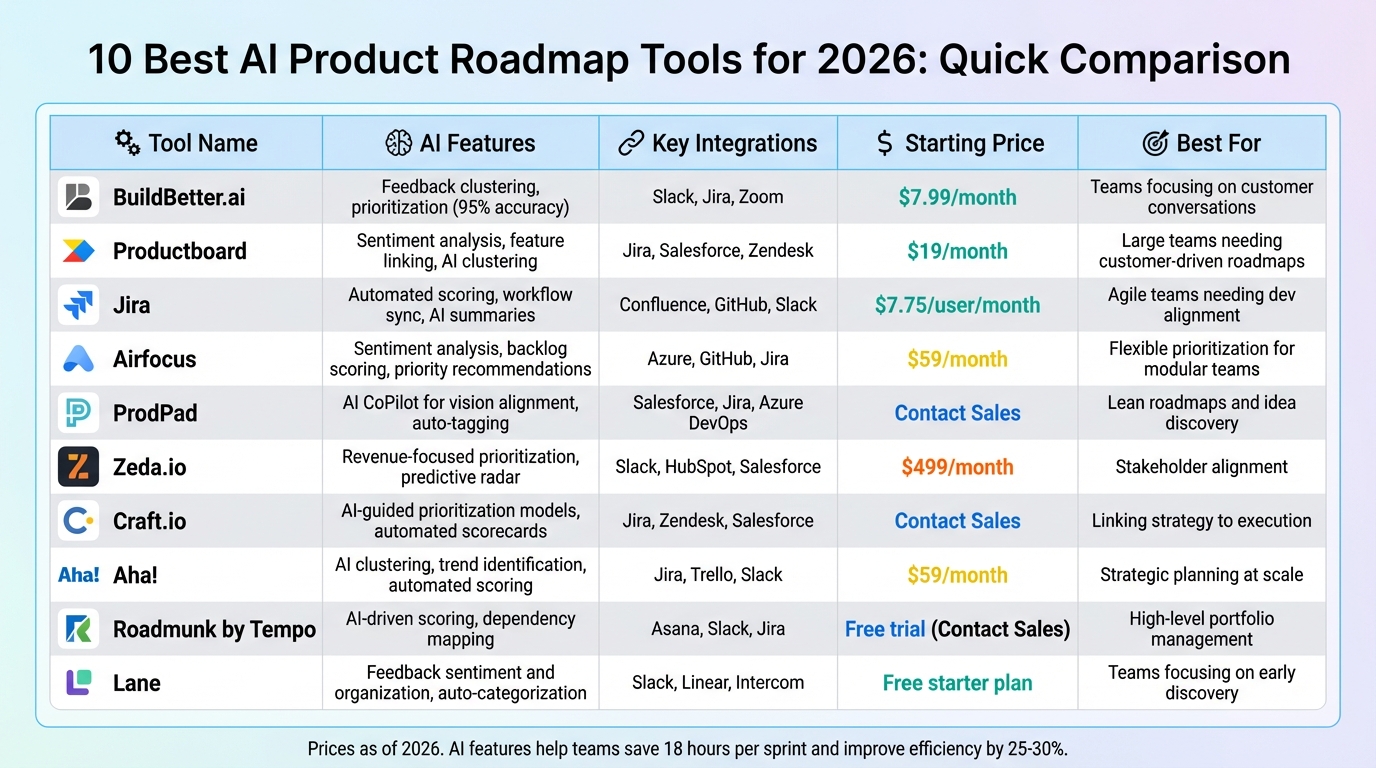
AI Product Roadmap Tools Comparison 2026: Features, Pricing & Best Use Cases
We Ranked Every AI Tool for Product Managers - So You Don’t Have To
1. BuildBetter.ai
BuildBetter.ai goes beyond the basics of support tickets and feature requests by pulling in both internal and external data streams. It gathers insights from customer calls, Slack conversations, surveys, and support interactions to create a well-rounded view of what users truly need. This multi-channel approach ensures product managers are no longer relying on incomplete information to make decisions.
AI-Powered Prioritization and Decision-Making
Using advanced AI clustering, BuildBetter.ai organizes thousands of data points to uncover hidden patterns, categorizing feedback by severity, impact, and emotion with an impressive 95% accuracy. This eliminates the need for manual tagging and significantly speeds up the process. Users have reported a 30% faster decision-making process and a 50% quicker transition from insight to action.
Jordan Carlson, Head of Product, shared how this works in real-world scenarios:
"I prompted BB to tell us the key features we should add or change based on this feedback. This is where BB really shined. It captured all user requests and prompted great discussion amongst the team".
With the CustomContext chat feature, product managers can ask focused questions, such as "What should our Q2 priorities be based on customer feedback?" - without the hassle of gathering and organizing data manually. This makes integrating customer feedback into roadmaps more seamless than ever.
Customer Feedback Integration and Analysis
BuildBetter connects with over 100 tools, including Zoom, Slack, Jira, Salesforce, Zendesk, HubSpot, and Intercom, to centralize customer interactions. By automatically converting raw conversations into structured documents and actionable insights, the platform speeds up the feedback loop by 60%. Teams also save an average of 18 hours per project during a standard two-week sprint, freeing up 43% more time for revenue-generating activities.
Integration with Jira and Linear ensures that prioritized roadmap items flow directly into engineering workflows. Stakeholders are automatically updated when requested features are shipped, eliminating the need for product managers to manually track and communicate updates. This streamlined process fosters better collaboration across teams.
Collaboration and Team Alignment Features
BuildBetter removes data silos by offering unlimited seats across all plans, allowing product, engineering, sales, and customer success teams to work from a single source of truth. This results in 26 fewer meetings per month and a 2x reduction in overall meeting volume.
John Strang from Product Operations highlighted the platform's impact:
"It wouldn't be possible to do my job at this scale without BuildBetter".
The platform boasts a 98% subscription retention rate among its 28,000+ customer organizations. Users frequently praise its ability to simplify complex roadmap discussions and provide clarity. Additionally, built-in privacy controls ensure customer data is never used to train AI models, and teams can customize internal privacy settings for recordings.
Pricing and Scalability for Different Team Sizes
BuildBetter uses a value-based pricing model, meaning you "only pay when you save time", rather than charging per seat. Plans start at $7.99/month for the Starter tier, which includes 120 minutes, 1 report, and 1 workflow. The Growing tier, at $200/month, offers 3,600 minutes with unlimited reports and workflows. For Scaling organizations, the cost is $800/month for 16,000 minutes.
Enterprise customers enjoy unlimited minutes, custom SSO/SAML, and dedicated success teams, with pricing tailored to their needs. Additional usage costs range from $0.06-$0.10 per minute and $0.35-$0.65 per feedback piece, depending on the plan.
2. Productboard
Productboard combines two powerful features, Spark and Pulse, to revolutionize roadmap planning. Spark accelerates planning by six times and automates updates, while Pulse acts as an AI-driven "Voice of Customer" tool. It analyzes feedback from CRMs, support platforms, and surveys to highlight the most requested features and emerging trends. Together, these tools create a data-focused foundation for smarter, more effective roadmap prioritization.
AI-Powered Prioritization and Decision-Making
Forget manual processes - Productboard uses AI to analyze user behavior, sentiment, and market trends. This creates predictive models that automatically connect feedback to specific feature ideas in the product hierarchy. The result? Every piece of customer feedback directly influences prioritization decisions. The platform even extracts critical insights from lengthy support threads, delivering concise "AI intent" summaries for quicker decision-making.
Christopher Fox, Director of Product Operations at Dashlane, shared:
"With Productboard AI we've seen an increase in our processing rate of notes jump from only 50% to remaining steady at above 80%".
This efficiency led to a 30% boost in linking customer notes to backlog features, improving prioritization accuracy. Salesforce also slashed its release planning time from three weeks to just three days by centralizing data-driven insights.
Customer Feedback Integration and Analysis
Productboard excels at feedback management by consolidating input from tools like Zendesk, Intercom, and Salesforce into a single searchable hub. Its AI automatically categorizes feedback, uncovering user insights and linking them to relevant features. Felipe Mury Botelho, Lead Product Operations at Zenchef, noted:
"Productboard AI has allowed us to collect, triage, and make decisions based on feedback from hundreds of restaurants across six countries and in eight different languages".
The Product Portal further strengthens this process by enabling teams to share planned features with customers, gathering validation before development begins. Iiro Nurmi from Smartly added:
"With Productboard AI we can summarize insights instantly and find new patterns from the feedback easily, rather than summarizing each note manually".
Collaboration and Team Alignment Features
Productboard also streamlines communication and alignment across teams. Role-specific views and Teamspaces ensure everyone stays on the same page with tailored updates and context. OutSystems reported a 30% productivity improvement after centralizing management for over 40 product managers. Anabela Cesário, EVP of Product Management at OutSystems, explained:
"Productboard has improved the productivity of our product teams by 30%. They are now able to understand product strategy and use Productboard on a daily basis to make decisions".
Autodesk, meanwhile, scaled operations across 20 teams in just two months by centralizing intake processes and enabling go-to-market teams.
Pricing and Scalability for Different Team Sizes
Productboard offers flexible pricing to suit teams of various sizes. The Essentials plan starts at $19 per maker/month (billed annually) and includes 250 feedback notes, 1 teamspace, and 1 product portal. The Pro plan costs $59 per maker/month (also billed annually) and provides unlimited feedback notes, 3 teamspaces, and trended reporting. For larger organizations, Enterprise pricing is customized and includes unlimited teamspaces, strategic planning features, SAML SSO, and Salesforce integration. Productboard AI is available as a paid add-on for both Pro and Enterprise plans.
3. Jira
Jira stands out as a go-to tool for product teams, helping them turn scattered data into organized, actionable roadmaps. With Jira, feedback no longer sits idle - it’s transformed into clear priorities that guide decision-making. The Jira Product Discovery feature acts as a central hub for capturing unstructured work, user feedback, and feature requests. Teams can then prioritize these inputs based on their actual impact rather than relying on guesswork. Already trusted by over 10,000 customers, Jira’s AI capabilities make prioritization faster and more informed.
AI-Powered Prioritization and Decision-Making
Jira’s roadmapping tools get a major boost from Atlassian Intelligence and Rovo, which add powerful AI-driven capabilities. Rovo’s "repository intelligence" digs into the history and context of work across Jira and Confluence, providing smarter insights. Meanwhile, AI agents simplify planning by automating repetitive tasks. For example, the Activity Readiness Checker highlights tickets that lack detail or alignment, cutting down on unnecessary follow-up meetings.
Rovo Chat is another game-changer, allowing product managers to query product data directly and make faster decisions. With 61% of product managers already using AI and reporting efficiency gains of 25–30%, the impact is clear. As John Sayers, PMO Lead at Renaissancere, explains:
"Jira Product Discovery is helping us do the right things, in the right order, and at the right time, focusing on work that will deliver on benefits".
Jira also bridges the gap between high-level ideas and delivery tickets, ensuring visibility throughout the software lifecycle. By automating repetitive tasks, these tools can save product managers 50–60% of their time. It’s no surprise that high-performing teams are 45% more likely to use AI-powered tools compared to just a year ago. Beyond prioritization, Jira strengthens team collaboration with tailored roadmaps for stakeholders.
Collaboration and Team Alignment Features
Distributed teams thrive with Jira’s custom stakeholder roadmaps, which provide tailored board and timeline views for different audiences, such as leadership or key customers. During the discovery phase, teammates can interact with ideas by commenting, reacting, or even voting to build consensus on product strategies. Abby Kiesling, Product Manager at EZ Texting, shares her experience:
"Jira Product Discovery combines everything I was doing in spreadsheets and Powerpoints into one easy-to-navigate tool. Plus everything is added straight into Jira, instead of requiring some third-party tool to integrate".
Jira ensures a seamless transition from discovery to delivery by linking roadmap ideas directly to delivery tickets. This way, developers have full context on why specific features were prioritized, without needing to switch tools. Additionally, Rovo’s AI-powered definitions help remote teams navigate company-specific jargon, easing communication in asynchronous setups. John Daily, Jr., Head of Product at Karhoo, highlights this benefit:
"Up until Jira Product Discovery, even with other roadmapping tools, we've had to use shared spreadsheets and slide presentations to coordinate prioritization in an accessible way".
Pricing and Scalability for Different Team Sizes
Jira offers flexible pricing to accommodate teams of all sizes. For small teams, there’s a Free tier. The Standard plan includes essential project management and AI features, with Rovo access expected to roll out in 2025. Scaling teams can opt for the Premium plan, which includes advanced roadmapping, cross-team views, and additional automation. This plan also provides early access to Rovo starting in April 2025. For larger organizations, the Enterprise plan offers top-tier security and administrative controls. Both Premium and Enterprise tiers come with Atlassian Intelligence features, which can summarize lengthy comment threads and generate project descriptions, making it easier for teams to scale efficiently.
4. Airfocus
Airfocus leverages its AI Assist feature to streamline backlog scoring and fine-tune priorities using historical data and strategic goals. With slash commands, users can quickly generate ideas, PRDs, and vision statements [21, 22]. The tool calculates priority scores by weighing factors like impact, effort, and strategic alignment, reducing internal bias. Beyond scoring, AI Assist performs sentiment analysis on customer feedback and automatically links relevant snippets to roadmap items, significantly speeding up the product discovery process [19, 22]. This smart prioritization creates a smooth pathway for integrating feedback into development.
Customer Feedback Integration and Analysis
Airfocus integrates seamlessly with tools like Slack, Zendesk, Intercom, and Salesforce, connecting feedback directly to roadmap items. Its sentiment analysis feature helps identify critical user concerns. Bruno Ballester, Product Manager at Royal Canin, shared his experience:
"I am happy to have airfocus to score my items and prioritize my backlog. What's great is that, because of this level of prioritization, we can all have an open discussion and have a better understanding of why we are doing certain things."
Collaboration and Team Alignment Features
Airfocus doesn’t just stop at prioritization. Its Priority Poker feature allows cross-functional teams to collaboratively rate and prioritize tasks, fostering consensus and highlighting any gaps in decision-making [19, 20]. To further enhance collaboration, the platform offers unlimited free viewer accounts so stakeholders can view and comment as needed.
Integration is another strong point. Airfocus syncs in real time with Jira, Trello, Slack, Microsoft Teams, and Azure DevOps [22, 24]. Additionally, its AI Assist simplifies technical language and condenses long feedback into actionable insights. A standout example of its capabilities comes from Papirfly, which used Airfocus in 2025 to unify 32 products and over 300 services. This transformation, which they estimated would take 2–3 years with traditional tools, was completed in just 12 months. Craig Unsworth, Papirfly’s CPO, remarked:
"With airfocus, we built a unified setup for 32 products and over 300 services in just 12 months (instead of 2-3 years). The power of the tool helped us navigate this complex transformation by providing constant clarity around our product vision & strategy."
Pricing and Scalability for Different Team Sizes
Airfocus offers flexible pricing options to suit various needs. Plans start at $19/month for individuals and $69/month for teams, with Professional and Enterprise tiers available for those requiring advanced features like a 3-level custom hierarchy, OKRs, capacity planning, and AI Assist [22, 25]. Enterprise users also benefit from extras like SAML SSO, priority support, and a dedicated success manager. Special discounts are available for startups, nonprofits, and educational institutions.
5. ProdPad
ProdPad's AI CoPilot serves as a strategic partner by evaluating backlog ideas against your product vision and OKRs. It then suggests targeted roadmap initiatives and calculates balanced priority scores, helping product managers focus on high-level decision-making instead of manual triaging. Chiara Gardner, Senior Product Manager at Gearset, highlighted its impact:
"CoPilot is a game changer... Loving its generative powers and not starting from a blank sheet of paper. Extra impressive results given that ours is quite a niche B2B product."
Customer Feedback Integration and Analysis
ProdPad also excels at feedback analysis. Its Signals tool automatically identifies recurring themes in customer feedback, while CoPilot summarizes lengthy entries and links them to relevant backlog ideas, ensuring teams can close the feedback loop when features are delivered. Feedback from multiple channels - like Slack, Salesforce, Intercom, and UserVoice - is routed seamlessly into the platform. The AI also detects duplicate feedback and connects related items, cutting down on tedious manual cleanup. Maggie Lubberts, VP of Product Management at Allovue, shared her thoughts:
"ProdPad filled in the blanks that other product management products seemed to skip over by connecting the ideas we were working on with the related customer feedback."
Collaboration and Team Alignment Features
Alignment across teams is another major focus. ProdPad employs Now-Next-Later roadmaps that prioritize outcomes over rigid timelines, ensuring stakeholders understand the reasoning behind decisions. Additionally, CoPilot can answer stakeholder questions based on your product's strategy, reducing administrative tasks. By using Retrieval-Augmented Generation (RAG), the platform accesses your company’s specific product data, vision, and history, minimizing inaccuracies from the AI. Mark Roke, Technical Product Manager at Clearvision, shared his experience:
"I pitched and presented a roadmap recently to our CEO. It didn't take any explanation. It just made perfect sense. They just get it."
Pricing and Scalability for Different Team Sizes
ProdPad’s pricing starts at around $20 per editor per month. As of late 2025, CoPilot is included at no additional cost for all paying customers. The platform offers unlimited feedback portals and an Enterprise option for large-scale portfolio management. To ensure data security, each CoPilot instance operates in isolation.
6. Zeda.io
Zeda.io takes a unique approach to aligning product strategies with revenue goals, offering AI-powered tools that streamline decision-making and collaboration.
AI-Powered Prioritization and Decision-Making
Zeda.io stands out with its revenue-focused roadmap, prioritizing features that directly impact business outcomes. By integrating with CRMs like Salesforce and HubSpot, as well as analytics platforms such as Amplitude and Mixpanel, product managers can pinpoint features associated with lost deals and revenue opportunities. Its AI Product Intelligence converts customer sentiments, segments, and tags into actionable "Product Areas". Meanwhile, the Predictive Opportunity Radar helps forecast potential customer issues and highlights new opportunities.
Dan Dalton, Head of Product & Design at Flock, praised the platform, saying:
"It's amazing how Zeda.io focuses on revenue in product discovery and planning. It blends individual feedback with broader product insights for strategic roadmap planning."
Teams leveraging Zeda.io have reported impressive results, including up to 50% growth in sales, a 20% drop in customer churn, and savings of over 90 hours typically spent on manual feedback aggregation. However, it's worth noting that the AI Product Insights feature becomes available only after collecting 200 feedback entries.
Customer Feedback Integration and Analysis
Zeda.io simplifies feedback collection and analysis with over 5,000 integrations, including Slack, Intercom, and Zendesk. Its AI capabilities summarize transcripts, generate release notes, and automate the feedback loop, cutting down on manual tasks. The "Ask AI" tool further empowers product managers by validating their hypotheses against real customer data before committing resources.
Aaron Lopez, Senior Product Manager at Branch, highlighted the platform's value:
"Zeda.io is an intuitive AI platform that empowers teams to enhance their product development by gaining deeper insights into customer desires."
Collaboration and Team Alignment Features
Zeda.io fosters collaboration by breaking down silos across Product, Sales, Marketing, and Customer Success teams. Its centralized dashboard consolidates customer insights, ensuring product strategies align with execution. The platform also offers public roadmaps for external transparency and customizable visualizations tailored to different internal audiences. For engineering teams, Zeda.io integrates seamlessly with tools like Jira, Linear, Asana, and Trello, keeping development efforts aligned with product priorities.
Snehasri Purama, Sr Manager at Sprinque, shared:
"The biggest problem Zeda.io has solved for us is alignment. As a company, all teams have different visions for the long-term. Zeda.io has helped bring everyone together while increasing the visibility across teams."
Pricing and Scalability for Different Team Sizes
Zeda.io starts at $499 per month, billed annually. It includes a 14-day free trial and offers a 90-day prorated refund policy. Designed to scale, the platform accommodates teams managing anywhere from 100 to 100,000 feedback entries. With ISO 27001 certification, it ensures enterprise-grade security. Best of all, the base price covers all features, including AI product insights and the extensive suite of integrations.
7. Craft.io
Craft.io is a comprehensive product management platform that bridges the gap between strategy and execution. At its core is the Guru™ Intelligence Layer, which integrates industry best practices to streamline workflows and decision-making.
AI-Powered Prioritization and Decision-Making
The Guru™ layer is packed with tools like pre-built templates and prioritization models designed to ensure that every initiative aligns seamlessly with your OKRs and business goals.
Sagar Medandarao, Product Management CoE at Fannie Mae, highlighted the platform's impact:
"Now that we have a software solution designed specifically for product management, our agile teams are able to connect OKRs directly to items on their roadmaps and quickly weigh competing items by applying the prioritization models built right into Craft.io."
Craft.io also offers capacity planning visualizations, helping teams assess their resources before moving projects into execution tools like Jira. Additionally, it organizes customer feedback through tagging and sorting, uncovering actionable insights that support smarter decision-making. These AI-powered features create a strong foundation for collaboration and efficiency.
Collaboration and Team Alignment Features
Beyond prioritization, Craft.io strengthens team collaboration by centralizing all product-related data into a single, easily accessible hub. This "single source of truth" enables real-time progress tracking and offers customizable roadmap views, from Kanban boards to detailed capacity planning, catering to different team needs. The platform’s two-way integrations with tools like Jira, Salesforce, Zendesk, and Intercom ensure fluid data sharing between discovery and execution stages.
Matt Jackson, Group Product Manager at Kingfisher, emphasized its value:
"Craft.io makes it so easy to tie everything we do to OKRs and other metrics that it's proving to be one of the most valuable tools in Kingfisher's move to a product-led culture."
Pricing and Scalability for Different Team Sizes
Craft.io is built to scale, offering portfolio management features that allow organizations to oversee all product data in one unified space. It provides tailored workspaces for a variety of roles, including CPOs, Product Ops teams, and UX/UI designers, making it ideal for cross-functional teams of any size. Whether you're a small team or managing enterprise-wide portfolios, Craft.io adapts to your needs with flexible pricing options for larger deployments.
8. Aha!
Over a million product builders trust Aha! to simplify large-scale product operations. With over 10 million features managed and more than 8 million ideas collected, this platform has become a cornerstone for product teams worldwide.
AI-Powered Prioritization and Decision-Making
Aha!’s AI assistant takes the guesswork out of decision-making by offering recommendations based on projected outcomes. It automates tasks like scoring and effort estimation, helping product managers prioritize more objectively. This means clearer requirements and a better understanding of development efforts.
One standout feature is its ability to identify strategic opportunities. By combining market research with internal data, the AI highlights high-value initiatives. It also processes customer feedback to uncover key themes and prioritize impactful requests, ensuring your roadmap reflects customer needs.
Gianna R., a Senior Product Manager, shared her thoughts:
"Aha! Roadmaps has truly transformed the way we handle product planning and prioritization in our company."
These insights integrate directly into Aha!'s collaboration tools, streamlining execution across teams.
Collaboration and Team Alignment Features
Aha! equips teams with tools to stay aligned and work efficiently. Aha! Whiteboards enable real-time brainstorming, allowing teams to map out flows, create mockups, and build roadmaps on the spot. Aha! Knowledge acts as a central hub for documenting processes and technical guides, while Aha! Develop connects engineering work to product strategy, supporting Scrum, Kanban, and SAFe methodologies.
The platform’s auto-updating presentations save time by eliminating manual status reporting. For instance, Sensormatic saved 500 hours annually, and BAE Systems reduced time spent tracking project status by 30%. With integrations for tools like Jira, Azure DevOps, Slack, and Salesforce, Aha! ensures smooth communication across departments.
Michael Morris, Director of Global Product Management at Experian, highlighted its value:
"Aha! provides a complete picture across our entire portfolio. We can quickly access product information at any level and see how it ties to the overall strategy."
Pricing and Scalability for Different Team Sizes
Aha! offers flexible pricing tailored to teams of all sizes.
- Premium Plan: $59 per user/month, covering strategy setting, roadmaps, and the AI assistant.
- Enterprise Plan: $99 per user/month, adding unlimited free reviewers and viewers.
- Enterprise+ Plan: $149 per user/month (annual only), including OKRs, capacity planning, and automation rules.
For startups, there’s a special Startup pack. Larger organizations benefit from unlimited reviewer seats in Enterprise plans, where only active product managers incur costs. All plans include a shared pool of AI credits, with options to purchase more if needed. Plus, a 30-day free trial is available - no credit card required.
9. Roadmunk by Tempo
Used by over 30,000 companies worldwide, Roadmunk (now part of Tempo's Strategic Roadmaps) helps product teams move from reactive planning to a more data-driven approach. By combining AI-powered workflows with strong collaboration tools, it ensures teams stay focused on what matters most.
AI-Powered Prioritization and Decision-Making
Roadmunk takes AI-driven planning to the next level with its Idea Manager, which centralizes product ideas in one place. This tool leverages frameworks like Value vs. Effort and RICE scoring to pinpoint initiatives with the most impact. By relying on objective criteria, it reduces the risk of decisions being swayed by stakeholder biases. Plus, customer feedback directly informs product ideas, ensuring that roadmap decisions are rooted in real user needs.
The platform also integrates seamlessly with Jira and Azure DevOps, syncing high-level strategies with everyday development tasks. These integrations help teams work more efficiently.
Collaboration and Team Alignment Features
Roadmunk's Portfolio Roadmaps bring together team roadmaps for organization-wide visibility, making it easier for executives to see how individual tasks align with broader company strategies. The Linked Items feature highlights dependencies - like Blocking, Moves With, and Relates To - helping teams understand how cross-functional initiatives connect.
Lauren Kaeppner, a Product Team Leader at Staples, shared how Strategic Roadmaps resolved a visibility issue for her team of 10 product managers. The clarity it provided impressed the executive team so much that they expanded its use company-wide.
"Adopting Strategic Roadmaps into our product management organization has transformed how we manage our products. Strategic Roadmaps helps each of my product managers remain focused on the right mix of transformative efforts and backlog items for each of their products."
Other collaboration features include Reviewer seats, which allow executives and stakeholders to comment on roadmaps without making edits, and unlimited filtered views, enabling teams to tailor presentations for various audiences. Roadmunk also integrates with tools like Asana, Monday.com, Trello, GitHub, and Slack to streamline communication.
Pricing and Scalability for Different Team Sizes
Roadmunk offers a 14-day free trial that includes feedback, idea management, and roadmapping tools. Its Business Package provides full access to roadmapping and prioritization features, with pricing based on three user roles: Account Admins, Collaborators (create/edit), and Reviewers (view/comment). Stakeholders without paid licenses can still access exported roadmaps in formats like PNG, interactive HTML, or password-protected URLs at no extra cost. With ISO/IEC 27001:2013 and 27701:2019 certifications, the platform ensures enterprise-grade security, making it suitable for teams of any size.
10. Lane
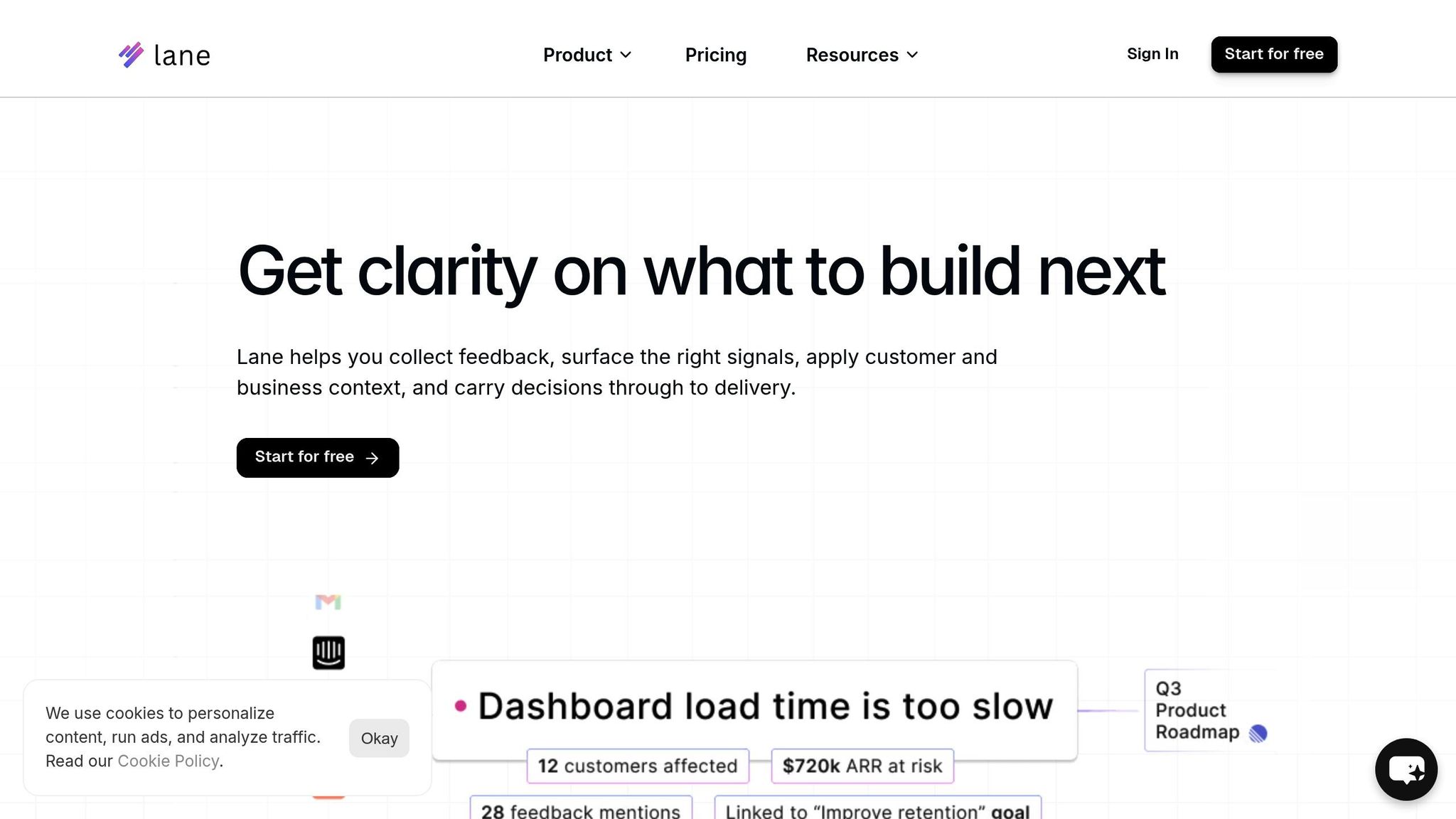
Lane describes itself as a product discovery layer that integrates seamlessly with tools like Linear and Jira. It focuses on helping teams understand the "why" and "what" of a project before jumping into development. With built-in AI, Lane organizes feedback by type, sentiment, and product area, uncovering patterns automatically. This approach lays the groundwork for smarter, AI-driven decision-making.
AI-Powered Prioritization and Decision-Making
Lane’s AI does more than just categorize feedback. It condenses lengthy conversations and recurring input into concise, actionable insights, turning scattered customer feedback into organized, meaningful data. The platform prioritizes features based on a mix of customer needs, business impact, and strategic goals, removing the guesswork from decision-making. Over time, as feedback and outcomes accumulate, Lane’s AI becomes more precise, surfacing clearer signals and reducing the manual effort involved in planning.
"Intelligence that helps you understand, prioritize, and plan better."
One standout feature is how Lane preserves the "why" behind every decision. Unlike traditional tools where the reasoning behind decisions fades after a feature is shipped, Lane keeps this context intact. This allows teams to revisit past decisions and understand the factors that influenced them.
Customer Feedback Integration and Analysis
Lane excels at capturing feedback directly from Slack threads, syncing entire conversations instead of just summaries to ensure nothing is lost. It also gathers input from tools like Intercom and email, consolidating and categorizing insights by type, sentiment, and product area. This comprehensive approach ensures teams have a complete picture of customer needs.
Collaboration and Team Alignment Features
Lane’s Public Roadmaps create a shared space where stakeholders and customers can see what’s being built, along with the reasoning behind it and real-time progress updates. The platform connects planning with execution by pushing decisions into Linear, complete with all relevant context. This alignment ensures that when engineering teams start work, they not only know what to build but also why it’s important.
Pricing and Scalability for Different Team Sizes
Lane offers a free starter plan, making it easy for teams to get started. For larger organizations or those with more complex needs, there’s a "Book a Demo" option to explore enterprise-level features and custom setups. The platform supports planning at every level, from high-level strategic roadmaps to detailed release and feature plans, allowing teams to scale their processes as they grow.
Feature Comparison Table
When selecting the right AI product roadmap tool, it's important to evaluate factors like AI features, available integrations, pricing, and how well the tool aligns with your team's needs. Below, you'll find a table that breaks down these key aspects across ten tools, offering a straightforward comparison.
Product managers who use AI for automating feedback processes have reported saving up to 18 hours per two-week sprint. Meanwhile, users of Productboard noted an 80% boost in the speed of processing customer feedback. These time savings emphasize the growing importance of AI features like automated feedback synthesis, sentiment analysis, and predictive modeling that estimates adoption rates and ROI based on historical data.
Here’s the comparison:
| Tool | AI Prioritization Features | Integrations | Starting Price (USD) | Recommended Use Case |
|---|---|---|---|---|
| BuildBetter.ai | Extracts insights from calls and meetings; identifies product opportunities from feedback. | Slack, Zoom, Jira, Salesforce | $7.99/mo | Ideal for growing B2B teams focused on customer conversations. |
| Productboard | AI-assisted clustering, sentiment analysis, and trend detection via "Pulse." | Jira, Slack, Amplitude, Mixpanel | $19/mo | Best for large teams needing customer-driven roadmaps. |
| Jira | AI summaries, risk alerts, and automated scoring and idea capture. | Slack, GitHub, Confluence | $7.75/user/mo | Designed for large, agile teams requiring dev alignment. |
| Airfocus | Recommends priority scores, sentiment analysis, and AI drafting for user stories. | Jira, Slack, Azure, GitHub | $59/mo | Great for teams needing flexible, modular prioritization. |
| ProdPad | AI tagging and deduplication; matches ideas to strategic goals via CoPilot. | Jira, Azure DevOps, Salesforce | Contact Sales | Works well for teams focused on lean roadmaps and idea discovery. |
| Zeda.io | Streamlines feedback collection and cross-functional collaboration. | Slack, Jira | N/A | Suitable for teams prioritizing stakeholder alignment. |
| Craft.io | AI assistant for PRDs and insights; automated prioritization scorecards. | Jira, Slack | N/A | Perfect for growing teams needing strategy-to-delivery alignment. |
| Aha! | AI idea clustering, automated release notes, and trend identification. | Jira, Slack, Trello | $9/mo | Tailored for strategic planning and large-scale roadmapping. |
| Roadmunk by Tempo | Scoring and prioritization models; visual roadmap automation. | Jira, Slack | N/A | Ideal for large teams needing high-level portfolio views. |
| Lane | N/A | N/A | N/A | N/A |
Pricing for entry-level plans ranges from $7.75 to $59/month, with AI capabilities spanning from basic clustering to more advanced predictive modeling. This table highlights how AI-driven prioritization tools are transforming the way product roadmaps are created and managed.
Conclusion
AI-powered roadmap tools are reshaping how product teams operate in 2026. These tools replace guesswork with data-driven scoring, streamline tedious documentation processes, and transform scattered feedback into actionable insights in just minutes. Companies that have embraced AI report a 25% to 30% boost in product development efficiency, highlighting the tangible benefits of this shift. This evolution enables teams to approach product planning with a more predictive and strategic mindset.
The transition from reactive planning to predictive execution is a game-changer. Teams can now estimate how a feature might impact key metrics like retention and ROI even before development begins. As Carlos Gonzalez de Villaumbrosia, Founder & CEO of Product School, aptly states:
"AI roadmaps? They aim to tell the story of what's most likely to matter."
To get started, focus on a single use case - such as feedback clustering - to showcase the value of AI, then expand its role gradually. Make sure the tool you choose integrates smoothly with your existing workflows to prevent data silos. As discussed earlier, incorporating AI enhances both speed and objectivity, but it's important to view AI as a support system - an analytical assistant that complements, rather than replaces, human decision-making.
When selecting an AI roadmap tool, consider factors like team size, goals, available data, and budget. The right tool should not only improve efficiency but also enrich your decision-making by blending intuition with data-backed insights. Regularly auditing data inputs, establishing governance protocols, and reviewing AI-generated recommendations can help reduce bias and ensure optimal outcomes. The future of product strategy lies in a balanced partnership between humans and AI - where technology handles the heavy lifting, freeing you to focus on creating products that address real-world challenges.
FAQs
How can AI tools enhance product roadmap decision-making?
AI-powered roadmap tools simplify the overwhelming task of turning complex product data into actionable steps. They empower product managers to base their decisions on data-driven insights rather than gut feelings. By digging into customer feedback, usage stats, and market trends, these tools uncover emerging needs and predict how different initiatives might play out. The result? Teams can focus on what truly matters.
These tools also take the heavy lifting out of data analysis. Using natural language processing, they can sift through massive amounts of information - like support tickets or survey responses - in record time. This not only speeds up the planning process but also assigns clear prioritization scores, cutting down on manual work and reducing bias. Plus, it fosters better collaboration across teams.
Another standout feature is real-time scenario modeling. With this, teams can explore "what-if" situations and predict outcomes with impressive accuracy. By quantifying risks, estimating potential revenue, and calculating time-to-market, these tools help product leaders make quicker, more confident decisions that align with market needs.
What should I look for when choosing an AI-powered product roadmap tool?
When picking an AI-powered product roadmap tool, it's important to focus on integration, AI features, and collaboration tools. Make sure the tool works smoothly with your current platforms - like CRM systems, design software, or communication apps. This can save time and cut down on manual tasks. Pay attention to AI capabilities that solve real problems, like analyzing feedback, offering predictive forecasts to prioritize features, or providing suggestions aligned with your business goals.
Collaboration matters, too. Look for tools that support real-time updates, shared roadmaps, and role-based access to keep everyone on the same page without version-control headaches. Don’t overlook pricing and scalability - choose a tool with clear pricing and the flexibility to grow as your team expands.
Lastly, think about usability and security. A simple, intuitive interface ensures faster onboarding and less downtime, while strong data protection measures help maintain customer trust. By keeping these factors in mind, you’ll find a tool that boosts your product strategy and streamlines your workflow.
How do AI tools help product teams align their roadmap with business goals?
AI-powered roadmap tools transform business goals into clear, actionable plans by leveraging data-driven insights. These tools analyze various inputs - such as market trends, customer feedback, financial targets, and historical performance - to pinpoint initiatives that are most likely to achieve critical outcomes like boosting revenue, lowering churn, or capturing more market share. The result? Every item on the roadmap is directly tied to measurable objectives, cutting out guesswork and ensuring a sharper strategic focus.
These tools also make prioritization a breeze. By evaluating factors like impact, effort, and risk for each potential feature or initiative, they rank options based on the company’s strategic goals. This allows teams to make smarter decisions faster. Plus, real-time scenario analysis helps product managers see how changes - like adjusting timelines or reallocating resources - might affect broader objectives, ensuring the roadmap stays adaptable and aligned.
Another big win? Improved collaboration. AI consolidates insights from various sources - like customer feedback and usage data - into easy-to-digest visual summaries. This shared clarity keeps everyone, from product teams to stakeholders, on the same page. It breaks down silos and ensures the roadmap evolves with the company’s changing needs.