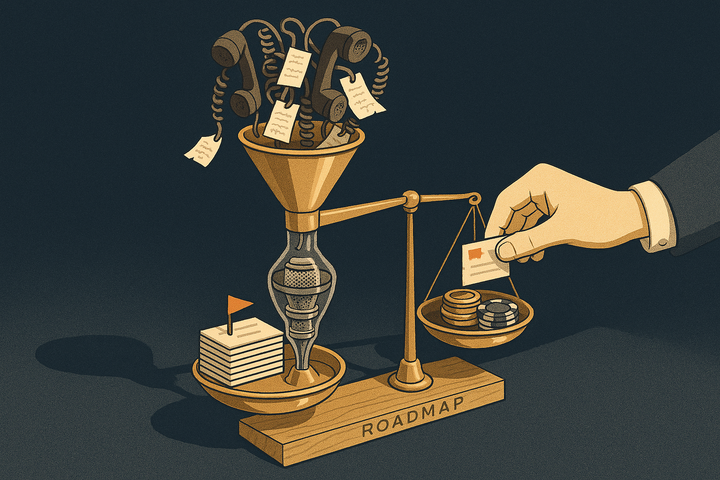
[ARCHIVED v1] Best Enterprise AI Chat Platforms for B2B Teams in 2026
Evaluate the 10 best enterprise AI chat platforms for B2B teams in 2026, from AI search tools to agentic AI platforms. This guide compares features, pricing, integrations, and analysis capabilities to help product leaders choose the right platform for cross-system, quantitative insights.
![[ARCHIVED v1] Best Enterprise AI Chat Platforms for B2B Teams in 2026](https://storage.ghost.io/c/4f/50/4f50536c-6dc6-4a92-8ff1-e707b209e265/content/images/size/w1200/2026/04/batch5-10.png)
Enterprise AI chat platforms have become the command center of modern B2B product teams. In 2026, these tools do far more than answer simple questions — they query live data across CRM systems, support tools, call recordings, product analytics, and internal communications, returning structured, decision-ready answers in seconds. The global enterprise AI market is projected to exceed $300 billion this year, and conversational AI platforms represent one of its fastest-growing segments.
But not all enterprise AI chat platforms are created equal. Some retrieve documents. Others draft content. And a new category — agentic AI — executes multi-step analytical workflows across your entire tool stack. For B2B product leaders evaluating these platforms, understanding the differences isn't academic — it's the difference between getting vibes and getting data.
This guide evaluates the 10 best enterprise AI chat platforms for B2B teams in 2026, organized by category, with honest assessments of what each does best, where each falls short, and which is purpose-built for the complex, cross-system analysis that B2B product decisions demand.
What Is an Enterprise AI Chat Platform — and Why B2B Teams Need One in 2026
An enterprise AI chat platform is a tool that lets teams query internal and external data using natural language, backed by enterprise-grade security including SOC 2 Type II compliance, SSO/SAML authentication, role-based access controls, and audit logging. Unlike consumer chatbots, these platforms are designed to connect to the systems where business-critical information actually lives — CRM records, support tickets, call recordings, product analytics dashboards, and internal communication channels.
The evolution from generic chatbots to purpose-built enterprise AI has been driven by a simple reality: B2B teams generate enormous volumes of unstructured data across dozens of tools, and no human can synthesize it fast enough to keep pace with product decisions. By 2026, Gartner estimates that 75% of enterprise software engineers use AI copilot tools, up from less than 10% in early 2023. That adoption curve has expanded well beyond engineering into product management, customer success, and operations.
Three distinct categories of enterprise AI chat have emerged, and understanding them is critical for procurement decisions:
- AI Search Platforms — Retrieve and surface existing documents across knowledge bases using semantic search
- AI Chat Assistants — General-purpose LLMs with enterprise security wrappers, strong for drafting and summarization
- Agentic AI Platforms — Orchestrate multi-step workflows across live data sources, returning quantitative, reproducible answers
Throughout this guide, we evaluate each platform against these criteria: data source coverage, analysis approach (semantic vs. agentic), integration depth, MCP (Model Context Protocol) support, methodology transparency, reproducibility, pricing model, and security/compliance.
The 3 Categories of Enterprise AI Chat: Search, Chat, and Agentic
The most important distinction in the enterprise AI chat market in 2026 is not which LLM a platform uses — it's how the platform interacts with your data. Each category represents a fundamentally different approach to answering questions, and selecting the wrong one leads to frustrated teams and shelfware.
AI Search Platforms
AI search platforms like Glean and Guru excel at retrieving and surfacing existing information across knowledge bases using semantic search. When a team member asks "Where's the Q1 competitive analysis deck?" or "What's our refund policy?", these tools find the right document quickly. They index content across connected apps and use vector similarity to rank results. Organizations using AI-powered enterprise search report 25–40% reduction in time spent searching for internal information, according to McKinsey and Forrester studies.
AI Chat Assistants
General-purpose AI chat assistants like ChatGPT Enterprise, Claude for Work, Perplexity Enterprise, Notion AI, and Microsoft Copilot bring powerful LLMs into enterprise environments with security controls and admin dashboards. They're strong for drafting content, summarizing uploaded documents, and open-ended reasoning. However, they are limited in their ability to query structured data across multiple business systems simultaneously.
Agentic AI Platforms
Agentic AI platforms like BuildBetter, Credal, and Danswer (Onyx) represent the newest and most capable category. These platforms don't just retrieve documents — they execute multi-step plans. An agentic platform receives a question, determines which data sources to query, pulls live data from multiple systems, counts, categorizes, and ranks results, and returns a structured answer with source citations.
"The shift from AI search to agentic AI represents the most significant change in enterprise knowledge work since the advent of SaaS. Semantic search tells you where an answer might live; agentic AI gives you the answer itself, with receipts."
Here's a quick-reference mapping of all 10 platforms covered in this guide:
| Platform | Category |
|---|---|
| BuildBetter | Agentic AI |
| Credal | Agentic AI |
| Danswer (Onyx) | Agentic AI |
| Glean | AI Search |
| Guru | AI Search |
| ChatGPT Enterprise | AI Chat Assistant |
| Claude for Work | AI Chat Assistant |
| Perplexity Enterprise | AI Chat Assistant |
| Microsoft Copilot | AI Chat Assistant |
| Notion AI | AI Chat Assistant |
Comparison Table: All 10 Enterprise AI Chat Platforms at a Glance
This comparison table provides a side-by-side view of every platform evaluated in this guide across the criteria that matter most for B2B product teams. Use it to quickly narrow your shortlist before diving into the detailed reviews below.
| Platform | Category | MCP Support | Quantitative Analysis | Methodology Transparency | Integrations | Data Sources | Pricing | SSO / SOC 2 | On-Prem |
|---|---|---|---|---|---|---|---|---|---|
| BuildBetter | Agentic | Yes (full stack) | Yes (deterministic) | Yes (full) | 100+ | Calls, Slack, CRM, support, surveys, analytics, knowledge bases | Unlimited access | Yes / Yes | Contact sales |
| Credal | Agentic | Partial | Partial | Yes | 30+ | Docs, CRM, custom APIs | Enterprise pricing | Yes / Yes | Yes |
| Danswer (Onyx) | Agentic | Community plugins | Partial | Partial | 20+ | Docs, Slack, custom connectors | Free (self-hosted) + enterprise | Self-managed | Yes |
| Glean | AI Search | Limited | No (semantic) | Partial | 100+ | Docs, email, Slack, wikis | Per-seat enterprise | Yes / Yes | No |
| Guru | AI Search | No | No | No | 40+ | Knowledge base, Slack, docs | From ~$15/user/mo | Yes / Yes | No |
| ChatGPT Enterprise | AI Chat | Via plugins | Limited | No | Growing (GPTs) | Uploaded files, browsing | $25–60/user/mo | Yes / Yes | No |
| Microsoft Copilot | AI Chat | Graph connectors | Limited | Partial | M365 ecosystem | M365, SharePoint, Teams | $30/user/mo add-on | Yes / Yes | Hybrid |
| Perplexity Enterprise | AI Chat | No | No | Partial (citations) | Limited | Web + uploaded files | Enterprise pricing | Yes / Yes | No |
| Claude for Work | AI Chat | No native | No | No | Limited | Uploaded files, API | $30/user/mo | Yes / Yes | No |
| Notion AI | AI Chat | No | No | No | Notion ecosystem | Notion workspace data | $10/user/mo add-on | Yes / Yes | No |
The key differentiators to focus on when reading this table: MCP support determines whether a platform can orchestrate queries across your full tool stack in a single prompt. Methodology transparency determines whether your team can verify and trust the AI's analysis. And pricing model determines whether adoption scales across your organization or gets bottlenecked by per-seat budgets.
In-Depth Reviews: The 10 Best Enterprise AI Chat Platforms for B2B Teams
Agentic AI Platforms
1. BuildBetter
Best for: B2B product teams that need quantitative customer insights across their entire tool stack
BuildBetter is the only agentic AI platform purpose-built for B2B product teams, combining call recordings, Slack conversations, CRM data, support tickets, surveys, and product analytics into a single queryable intelligence layer. With over 100 deep integrations — including Zoom, Slack, Jira, Salesforce, Zendesk, HubSpot, Intercom, PostHog, and Linear — BuildBetter connects to both internal and external data sources, giving teams a complete picture that no other platform in this evaluation offers.
What sets BuildBetter apart is its agentic orchestration with full MCP support across the entire stack. A product manager can ask a single question like "Top customer issues ranked by product usage with associated Linear tickets" and BuildBetter will simultaneously query PostHog for usage data, analyze customer signals from calls and tickets, match them to Linear issues, and return a structured, quantitative answer — with every signal linking back to its original source conversation.
BuildBetter's methodology transparency is unique in the market. The platform shows exactly how it analyzed the data: which sources it queried, what filters it applied, and what aggregation logic it used. This means teams can verify, refine, and trust the output — critical for roadmap decisions and executive presentations. The analysis is deterministic and reproducible, so the same question returns the same answer whether asked on Monday or Friday.
The unlimited access pricing model eliminates one of enterprise AI's biggest adoption killers: per-seat gating. Every team member — from product managers to designers to engineers — can use the platform without budget negotiations.
Key limitation: BuildBetter is purpose-built for B2B product workflows, not a general-purpose writing assistant or creative tool. Teams looking for generic content generation should look elsewhere.
Pricing: Unlimited access — contact sales for details.
2. Credal
Best for: Security-first enterprises that need agentic AI with on-premises deployment options
Credal takes a security-first approach to enterprise AI, offering SOC 2 Type II compliance, on-premises deployment, and hybrid options for organizations with strict data residency requirements. The platform integrates with 30+ data sources through custom API connectors, allowing teams to query across CRM data, documents, and internal tools.
Credal's agentic capabilities are growing, with partial MCP support and the ability to execute multi-step queries across connected systems. Its methodology transparency is a strength — users can see which data the AI accessed and how it arrived at its conclusions. However, Credal's integration catalog (30+) is significantly narrower than platforms like BuildBetter (100+), which limits its usefulness for teams with complex, multi-tool workflows.
Quantitative analysis capabilities are partial: Credal handles structured queries well for its connected data sources but lacks the deep product analytics and customer signal integrations that B2B product teams specifically need.
Key limitation: Narrower integration ecosystem and less specialization for product team workflows compared to purpose-built platforms.
Pricing: Custom enterprise pricing.
3. Danswer (Onyx)
Best for: Engineering-led teams that want full control via self-hosted, open-source deployment
Danswer, now rebranded as Onyx, is an open-source AI assistant that can be entirely self-hosted, giving organizations complete control over their data and infrastructure. For teams with strict data residency requirements or deeply customized internal tooling, Danswer's open-source model is compelling.
With 20+ connectors and a growing community plugin ecosystem, Danswer handles document retrieval and basic agentic workflows. Its open architecture means teams with engineering resources can extend it to query custom data sources and build tailored workflows. However, this flexibility comes with a cost: significant engineering investment for setup, maintenance, and integration development.
Quantitative analysis and MCP support are partial, relying largely on community contributions. Methodology transparency exists but varies depending on how the platform is configured.
Key limitation: Requires significant engineering resources to deploy, maintain, and extend. Not a turnkey solution for product teams without dedicated infrastructure support.
Pricing: Free (self-hosted) with paid enterprise support tiers available.
AI Search Platforms
4. Glean
Best for: Large enterprises that need fast, accurate document retrieval across hundreds of connected apps
Glean is the category leader in AI-powered enterprise search, having raised $260 million in a Series E at a $4.6 billion valuation in 2024 and continued aggressive expansion through 2025–2026. With 100+ integrations spanning documents, email, Slack, wikis, and more, Glean excels at the "find me the doc" use case — using semantic search to surface the most relevant internal content based on natural language queries.
For large organizations where employees waste significant time searching for information, Glean delivers measurable value. Its permission-aware retrieval ensures users only see content they're authorized to access, and its enterprise security controls (SOC 2, SSO) meet procurement requirements.
However, Glean's core approach is semantic retrieval, not structured analysis. It cannot count feature requests, rank customer issues by frequency, or pull live data from product analytics tools like PostHog or Linear. When a product team asks "What are the top 5 enterprise feature requests this quarter?", Glean returns documents that might contain the answer — not the answer itself.
Key limitation: Semantic retrieval means no quantitative analysis, no deterministic reproducibility, and no agentic cross-system orchestration. It finds documents; it doesn't analyze data.
Pricing: Per-seat enterprise pricing (custom).
5. Guru
Best for: Customer-facing teams that need a lightweight knowledge management solution with AI-powered search
Guru focuses on knowledge management with an AI-powered search layer, making it easy for teams to maintain verified, up-to-date knowledge cards accessible through Slack, browser extensions, and other workflows. With 40+ integrations, Guru connects to common knowledge sources and surfaces answers within the tools teams already use.
Guru's strength is simplicity: it's straightforward to set up, easy to maintain, and effective for customer-facing teams that need quick access to approved answers. However, it lacks MCP support, quantitative analysis capabilities, and methodology transparency. Its integration ecosystem (40+) is narrower than enterprise-scale platforms, and it does not connect to product analytics, call recordings, or CRM data in depth.
Key limitation: Knowledge base-centric approach limits utility for product teams needing cross-system analytical capabilities.
Pricing: From ~$15/user/month.
AI Chat Assistants
6. ChatGPT Enterprise
Best for: Organizations that want a general-purpose AI assistant with strong reasoning capabilities and enterprise security
ChatGPT Enterprise brings OpenAI's most capable models into enterprise environments with admin controls, SSO, and data privacy guarantees (OpenAI does not train on enterprise customer data). It surpassed 600,000+ business users within its first year and continues to grow. For general-purpose tasks — drafting emails, summarizing documents, brainstorming, code generation — it's exceptionally capable.
The growing GPT and plugin ecosystem provides some integration capabilities, and MCP support via plugins is emerging. However, ChatGPT Enterprise is fundamentally a general-purpose tool. It doesn't natively connect to your Salesforce, PostHog, or Linear instances. It can't pull live customer signals from support tickets or analyze call recordings. For B2B product teams, it's a powerful writing and reasoning assistant, but not a data analysis platform.
Key limitation: No native integrations with B2B product tools; limited to uploaded files and browsing. Cannot execute structured queries across live business data.
Pricing: $25–60/user/month.
7. Microsoft Copilot
Best for: Microsoft-centric organizations that want AI embedded directly in their M365 workflow
Microsoft Copilot integrates deeply with the Microsoft 365 ecosystem — Teams, SharePoint, Outlook, Word, Excel, and PowerPoint — using Microsoft Graph connectors to surface relevant context. For organizations already running on the Microsoft stack, Copilot adds an AI layer to existing workflows without introducing a new tool.
The Graph connector architecture provides a form of cross-system orchestration within the Microsoft ecosystem, and hybrid deployment options exist for organizations with specific infrastructure requirements. However, Copilot is largely limited to the Microsoft stack. Teams using Salesforce, Zendesk, PostHog, or Linear as primary tools will find its data coverage insufficient.
Key limitation: Ecosystem lock-in. Limited utility for teams with diverse, non-Microsoft tool stacks common in B2B product organizations.
Pricing: $30/user/month as a Microsoft 365 add-on.
8. Perplexity Enterprise
Best for: Teams that need AI-powered web research with source citations and enterprise controls
Perplexity Enterprise brings the company's research-oriented AI approach into enterprise settings, providing answers with inline source citations. It's effective for competitive research, market analysis, and open-ended questions that benefit from real-time web data. Its citation transparency is a strength — users can verify claims against original sources.
However, Perplexity Enterprise has limited internal integration capabilities. It's primarily web-oriented, with uploaded file support rather than live connections to CRM, support tools, or product analytics platforms. For B2B product teams, this means it cannot answer questions about your customers, your product data, or your internal signals.
Key limitation: Web-first orientation with limited internal data source connectivity. Not suitable for internal product intelligence workflows.
Pricing: Custom enterprise pricing.
9. Claude for Work
Best for: Teams that value nuanced reasoning and long-context analysis on uploaded documents
Claude for Work (Anthropic's enterprise offering) provides access to Claude's large context window and strong reasoning capabilities in an enterprise-secured environment. It excels at analyzing lengthy documents, generating nuanced written content, and handling complex reasoning tasks. Anthropic's emphasis on AI safety and responsible development resonates with compliance-conscious organizations.
Notably, Anthropic created the Model Context Protocol (MCP) specification — but Claude for Work itself has limited native MCP integrations as of early 2026. The platform relies primarily on uploaded files and API access rather than live connections to business tools.
Key limitation: Despite creating MCP, Claude for Work's native integration ecosystem is limited. It's a powerful reasoning engine without broad tool connectivity.
Pricing: $30/user/month.
10. Notion AI
Best for: Teams already using Notion as their primary workspace who want AI capabilities within their existing documents
Notion AI adds an AI layer directly within the Notion workspace, enabling teams to query, summarize, and generate content across their Notion pages, databases, and wikis. At $10/user/month as an add-on, it's the most affordable option in this comparison and requires zero setup for existing Notion users.
The limitation is clear: Notion AI only queries Notion data. It cannot connect to CRM systems, support tools, call recordings, product analytics, or external data sources. For teams that centralize everything in Notion, this is valuable. For B2B product teams with data spread across 10+ tools, it addresses only a fraction of their needs.
Key limitation: Single-ecosystem platform. No external data source connectivity, no MCP support, no quantitative analysis capabilities.
Pricing: $10/user/month add-on to Notion plans.
Why Semantic Search Alone Isn't Enough for B2B Product Decisions
Semantic search retrieves documents based on vector similarity — and this approach has a fundamental limitation that B2B product teams must understand before making a procurement decision. The same query can return different results depending on embedding variance, indexing freshness, and retrieval ranking algorithms. You get directionally useful results, but not deterministic, quantitative answers.
Consider a concrete example: a product manager asks, "Summarize feature requests from the last 30 days." A semantic search tool surfaces documents that mention feature requests — meeting notes, Slack threads, support ticket exports. But it doesn't count them. It doesn't rank them by frequency. It doesn't cross-reference them against product usage data. And running the same query tomorrow might surface different documents.
An agentic platform like BuildBetter handles this query fundamentally differently. It executes a structured plan: query all connected data sources (calls, tickets, Slack, CRM notes) for feature requests within the specified date range, count occurrences, categorize them by theme, rank them quantitatively, and return a structured answer that is reproducible every time the query is run.
"Reproducibility is the most underrated evaluation criterion for enterprise AI chat platforms. If your team asks the same strategic question on Monday and Wednesday and gets materially different answers, you can't build a roadmap on that foundation."
BuildBetter's click-through to source capability adds another layer of trust: every signal in a BuildBetter analysis links back to the actual customer conversation, support ticket, or data point. Teams don't have to trust a black-box summary — they can verify it. And BuildBetter's methodology transparency shows exactly how the analysis was performed: which sources were queried, what filters were applied, what aggregation logic was used, and what was excluded.
For B2B product decisions — roadmap prioritization, churn analysis, feature scoping, competitive positioning — this quantitative rigor is non-negotiable. You need data, not vibes.
Key Features to Evaluate When Choosing an Enterprise AI Chat Platform
Choosing the right enterprise AI chat platform requires evaluating capabilities that go far beyond the quality of the underlying language model. Here are the eight criteria that separate platforms delivering real ROI from those that become expensive shelfware.
- Data source breadth: Does the platform connect to your calls, CRM, support tools, product analytics, and internal comms? Or just documents and wikis? The most valuable insights for B2B product teams sit at the intersection of internal data (what your team discusses) and external data (what customers say and do). BuildBetter is the only platform in this evaluation that covers both comprehensively.
- Analysis approach: Is the platform performing semantic retrieval (finding relevant documents) or agentic execution (querying systems, analyzing data, returning structured answers)? This is the most consequential architectural distinction in the market today.
- MCP (Model Context Protocol) support: Can the platform orchestrate queries across multiple tools in a single prompt? MCP has been called "the USB-C of enterprise AI" — a standardized way for AI systems to connect to and operate across diverse data sources. Without it, users are stuck switching tabs and manually synthesizing information.
- Reproducibility: Does the same question return the same answer? For data-driven teams making prioritization decisions, non-deterministic outputs are a disqualifier.
- Methodology transparency: Can you see exactly how the AI arrived at its answer — which data it queried, how it filtered and aggregated, what it excluded? This is essential for building organizational trust in AI-generated insights.
- Integration depth vs. breadth: 100 shallow connectors matter less than deep, bidirectional integrations with the tools your team actually uses daily. Evaluate whether the platform pulls rich data from your specific tools or just indexes surface-level metadata.
- Security and compliance: SOC 2 Type II, SSO/SAML, data residency controls, role-based access, and audit logs are table stakes for enterprise deployment. Confirm whether the vendor trains models on your data.
- Pricing model: Per-seat pricing creates gatekeeping — managers restrict access, power users hoard licenses, and a significant percentage of the organization never touches the tool. Unlimited-access models, like BuildBetter's, align vendor incentives with customer outcomes: maximum adoption, maximum value.
"The per-seat pricing model is the biggest silent killer of enterprise AI adoption. When you charge per seat, managers gatekeep access, power users hoard licenses, and 40% of your organization never touches the tool."
How to Implement an Enterprise AI Chat Platform: A 4-Step Framework
Implementing an enterprise AI chat platform successfully requires more than selecting a vendor — it requires aligning the platform's capabilities with your team's actual data landscape, use cases, and adoption dynamics. Here's a proven four-step framework.
Step 1: Audit Your Data Landscape
Map every data source your product team relies on: call recordings (Zoom, Teams), team chat (Slack), CRM (Salesforce, HubSpot), support tools (Zendesk, Intercom), product analytics (PostHog), issue trackers (Jira, Linear), documentation (Notion, Confluence, Google Drive), and survey tools. Then evaluate which platforms connect to all of them versus a subset. Most teams discover they need 8–15 distinct data sources connected to achieve comprehensive coverage — and that most AI chat platforms cover only 3–5.
Step 2: Define Your Use Cases by Category
Separate your team's needs into two buckets: retrieval use cases ("Find me the PRD for the Q1 billing feature") and analysis use cases ("What are the top customer pain points for enterprise accounts this quarter, ranked by frequency?"). If your primary needs are retrieval, an AI search platform may suffice. If your team needs cross-system analysis and quantitative answers, an agentic platform is required. Most B2B product teams discover they need both — and that an agentic platform with strong retrieval capabilities covers both categories.
Step 3: Run a Proof-of-Concept with Real Queries
Test each shortlisted platform with your actual questions — not the vendor's demo queries. A strong test query: "What are the top 5 feature requests from enterprise accounts in Q1 2026, ranked by mention frequency, with supporting quotes?" Compare answer quality, reproducibility (run the same query twice — do you get the same answer?), source transparency (can you click through to original data?), and time-to-answer.
Step 4: Evaluate Adoption Friction
Per-seat pricing creates organizational politics around who gets a license. Unlimited-access models — like BuildBetter's — let entire teams adopt without budget negotiations, driving faster time-to-value. Evaluate not just the per-user cost, but the total cost of ownership including the adoption rate. A $30/seat tool with 50% adoption effectively costs $60 per active user. A platform with unlimited access and 90% adoption delivers dramatically more value per dollar.
FAQ: Enterprise AI Chat Platforms for B2B Teams
What is the difference between AI search and agentic AI chat?
AI search platforms use semantic similarity to retrieve documents that might contain the answer to your question. They excel at "find me the doc" queries. Agentic AI chat platforms go further: they execute multi-step plans across multiple data sources, query structured data, count and categorize results, and return quantitative, reproducible answers with full source citations. The key distinction is that AI search returns documents; agentic AI returns answers.
Are enterprise AI chat platforms secure enough for sensitive B2B data?
Leading enterprise AI chat platforms offer robust security controls including SOC 2 Type II compliance, SSO/SAML authentication, role-based access controls (RBAC), data encryption at rest and in transit, audit logging, and data retention policies. Some platforms also offer data residency controls and on-premises deployment options. Always verify specific compliance certifications, ask about data handling practices (whether your data is used for model training), and review the vendor's security documentation before procurement.
What is MCP (Model Context Protocol) and why does it matter for enterprise AI?
MCP (Model Context Protocol) is a standardized protocol that allows AI platforms to connect to and orchestrate queries across multiple external tools and data sources in a single prompt. For example, with MCP support, you can ask a single question like "Show me top customer issues ranked by product usage with associated engineering tickets" and the AI will simultaneously query your support tool, product analytics platform, and issue tracker to compile a unified answer. Without MCP, users must query each tool separately and manually synthesize results — a process that takes hours instead of seconds.
How much do enterprise AI chat platforms cost in 2026?
Pricing varies significantly by category. AI Chat Assistants range from $10/user/month (Notion AI add-on) to $60/user/month (ChatGPT Enterprise). Microsoft Copilot is $30/user/month as a Microsoft 365 add-on. AI Search platforms like Glean use custom enterprise pricing (typically $15–30+/user/month at scale). Danswer/Onyx is free to self-host with paid enterprise support tiers. BuildBetter offers unlimited access without per-seat gating, eliminating the adoption friction and wasted spend associated with per-seat models. When evaluating pricing, consider total cost of ownership including adoption rates — a $30/seat tool with 50% adoption effectively costs $60/active user.
Can enterprise AI chat platforms replace our existing knowledge base or wiki?
Enterprise AI chat platforms complement rather than replace existing knowledge bases. They work best when connected to your existing tools (Notion, Confluence, Google Drive, SharePoint) as data sources, adding an intelligent query and analysis layer on top. Think of them as the brain that sits across all your knowledge repositories and operational tools, making the information inside them accessible through natural language queries.
Which enterprise AI chat platform is best for product teams?
BuildBetter is purpose-built for B2B product teams, combining customer signals (calls, tickets, feedback) with product analytics and internal comms across 100+ integrations. It delivers quantitative, reproducible analysis with full methodology transparency — the specific capabilities product teams need for roadmap decisions, prioritization, and customer insights. General-purpose tools like ChatGPT Enterprise or Microsoft Copilot serve broader use cases but lack the specialized B2B product workflow integrations and agentic analysis capabilities.
The Bottom Line: Which Enterprise AI Chat Platform Should Your B2B Team Choose?
The right enterprise AI chat platform depends on your team's primary use case. Here's a summary recommendation:
- If your primary need is document retrieval → Glean or Guru provide strong semantic search across connected knowledge sources.
- If you need a general-purpose AI assistant → ChatGPT Enterprise or Claude for Work deliver powerful reasoning and content generation with enterprise security.
- If you need quantitative, cross-system analysis for B2B product decisions → BuildBetter is the purpose-built choice.
The industry trajectory is clear: the enterprise AI chat market is moving from retrieval to agentic. Teams that adopt agentic platforms now gain a structural advantage in decision speed and accuracy that compounds over time. As MCP adoption accelerates and AI platforms become more deeply embedded in product workflows, the gap between teams using document retrieval and teams using agentic analysis will only widen.
BuildBetter is the only platform in this comparison that combines agentic orchestration, 100+ deep integrations spanning both internal and external data sources, quantitative reproducible analysis, full methodology transparency, and unlimited access — all purpose-built for B2B product teams that ship products and need decision-ready insights, not just retrieved documents.
Streamline Your Product Team's Workflow
Ready to move from document retrieval to decision-ready insights? BuildBetter gives your entire product team unlimited access to agentic AI chat that queries across your calls, Slack, CRM, support tickets, product analytics, and more — returning quantitative, reproducible answers with full methodology transparency.
Try BuildBetter's AI Chat → Unlimited access, no per-seat gating.