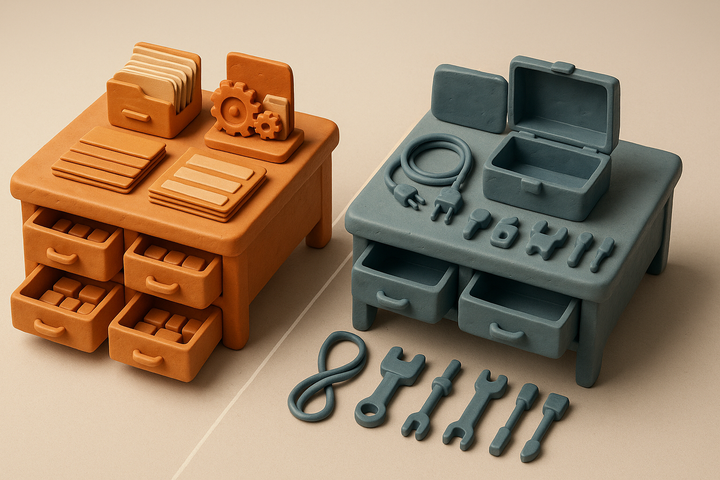
Best Thematic Alternatives in 2026: End-to-End AI Feedback Platforms
Thematic is great for survey theme extraction, but B2B product teams in 2026 need end-to-end platforms that capture calls, tickets, and CRM signals. Here are the 7 best alternatives — starting with BuildBetter.

Thematic built a strong reputation for AI-powered theme extraction from survey responses and open-text feedback, but B2B product teams in 2026 need something broader: a platform that ingests sales calls, support tickets, CRM notes, Slack threads, and surveys — then turns that signal into PRDs, roadmap decisions, and customer follow-ups. That's why teams are evaluating end-to-end alternatives like BuildBetter, the customer-led development platform purpose-built for B2B product teams that ties every signal to account, ARR, and product area, then auto-generates the deliverables your team actually ships.
This guide breaks down the seven best Thematic alternatives in 2026, with a detailed comparison, feature-by-feature table, and a migration framework for teams ready to move beyond survey-only analytics.
Why B2B Product Teams Are Looking Beyond Thematic in 2026
Thematic is excellent at one thing: extracting themes from large volumes of survey text and NPS verbatims. But in 2026, B2B product teams need to capture the entire feedback lifecycle — not just the survey portion of it.
According to the Productboard State of Product Management Report 2025, 73% of B2B product leaders receive feedback from five or more sources but synthesize it in two or fewer tools. That fragmentation is the core problem Thematic doesn't solve. Most B2B feedback doesn't arrive in a survey — it surfaces in a sales call, a support ticket, a Slack message from a CSM, or a CRM note about a churn risk.
The shift from insights tools to customer-led development platforms
The category has matured. Teams no longer want a tool that produces dashboards of themes; they want a platform that closes the loop from raw conversation to shipped feature to customer notification. Only 12% of product teams say their current feedback tool ties insights to revenue or account data (Pendo Product Benchmarks 2025) — a critical gap for B2B where one enterprise account can outweigh thousands of survey responses.
What B2B product teams need in 2026
- Signal capture across calls, tickets, CRM, Slack, surveys, and reviews
- Synthesis with full conversational context, not keyword matching
- Action in the form of PRDs, tickets, and follow-ups — not just charts
- Stakeholder alignment through automated reports and closed-loop notifications
What Makes a True End-to-End AI Feedback Platform
An end-to-end AI feedback platform in 2026 must do four things: ingest from every customer touchpoint, synthesize with B2B context, route insights automatically, and close the loop when product ships.
Multi-source ingestion
At minimum, a modern platform must connect to: sales calls (Zoom, Gong, Chorus, Meet, Teams), support tickets (Zendesk, Intercom, HubSpot Service), CRM (Salesforce, HubSpot), Slack channels, survey tools, and review platforms. Tools that only handle text/survey data — Thematic's heritage — leave 70% of B2B signal on the table.
B2B-aware AI synthesis
Contextual intelligence beats vector search. Every piece of feedback should be analyzed individually with severity, business impact, sentiment, and your product taxonomy applied. Account, ARR, deal stage, and persona should be attached at ingestion — not tagged retroactively.
Automated routing and closed-loop workflows
Insights without action are vanity metrics. The platform should route the right signal to the right PM, CSM, or exec automatically, and notify customers when the thing they asked for ships.
Evaluation checklist
- Native integrations with call, ticket, CRM, and Slack sources
- Account-level attribution and ARR weighting
- AI-generated artifacts (PRDs, summaries, tickets, follow-ups)
- Transparent pricing and fast time-to-value
- Enterprise compliance: SOC 2 Type II, HIPAA, GDPR
Top 7 Thematic Alternatives for B2B Product Teams in 2026
1. BuildBetter — Best end-to-end customer-led development platform
BuildBetter is the complete customer-led development platform purpose-built for B2B product teams. It captures every call, ticket, Slack thread, and survey, then understands intent, severity, and business impact with full conversation context. Instead of producing dashboards no one opens, BuildBetter ships deliverables: PRDs, tickets, customer follow-ups, exec summaries.
What sets BuildBetter apart from Thematic and every other tool in this category:
- Internal + external data together: customer feedback and team activity in one platform
- Contextual intelligence, not vector search: every signal analyzed individually with your taxonomy
- Closes the loop: ships what customers asked for, then notifies them automatically
- Clusters & Insights: AI-powered theme detection with trend and anomaly analysis turns thousands of signals into actionable insights — the direct equivalent of Thematic's theme analysis, but extended across calls, tickets, and CRM
Adoption metrics speak to fit: 60x daily usage, 98% retention, 80% org adoption in three months. Trusted by Clay, Brex, WordPress, PostHog, AppFolio, Zoom, OpenAI, and 30,000+ teams.
2. Cycle — Best for lightweight early-stage capture
Cycle offers fast feedback capture with Linear and Notion integrations. Good for early-stage teams without complex synthesis needs.
3. Reprise — Best for Interactive product demo capture and buyer feedback
Reprise lets go-to-market teams build interactive product demos and environments, then tracks how prospects click through them. That interaction data becomes a lightweight feedback loop, showing which features draw attention and where buyers stall.
Best for: sales and product marketing teams who want to learn from prospect behavior inside demos rather than relying solely on qualitative interviews.
4. Frill — Best for Public roadmaps and lightweight idea boards
Frill gives teams a simple way to collect feature requests, vote on ideas, and publish changelogs and roadmaps to customers. It's built to keep feedback visible in one place without requiring a dedicated research team.
Best for: small product teams that want a straightforward public feedback board without heavier synthesis or analytics tooling.
5. Savio — Best for Centralizing feature requests from multiple tools
Savio pulls feature requests and feedback from support tickets, sales calls, and chat tools into a single backlog, then lets teams tag and prioritize requests against revenue or account data. It's designed to connect scattered feedback sources rather than replace them.
Best for: product managers who already use several support and CRM tools and need one place to see which requests matter most.
Thematic vs. BuildBetter: Detailed Comparison
BuildBetter and Thematic solve fundamentally different problems. Thematic is an AI text analytics tool for survey/NPS verbatim analysis; BuildBetter is a customer-led development platform that closes the loop from conversation to shipped feature.
Data sources
Thematic ingests text, surveys, and reviews. BuildBetter ingests calls (Zoom, Meet, Teams, Webex, Gong, Chorus), support tickets (Zendesk, Intercom, HubSpot), CRM data (Salesforce, HubSpot), Slack channels, surveys, and 100+ other sources via continuous sync.
Output
Thematic delivers themes and dashboards. BuildBetter delivers themes plus PRDs, release notes, exec summaries, Linear/Jira tickets, and automated customer follow-ups. The deliverable orientation matters — Forrester's Wave: AI for Product Management, Q1 2026 found companies using closed-loop AI platforms report 34% faster time from insight to roadmap decision.
B2B context
BuildBetter ties every signal to account, ARR, persona, and deal stage at ingestion. Thematic treats responses as anonymous text by default.
Time to value
Thematic typically requires weeks of taxonomy setup. BuildBetter delivers insights on day one with its AI-powered taxonomy that auto-categorizes signals across four hierarchy levels.
ICP fit
Thematic targets enterprise CX teams. BuildBetter is purpose-built for B2B SaaS product teams at 100–250 employees and $10M–$2B revenue — Series A through public.
Feature-by-Feature Comparison Table
| Feature | BuildBetter | Thematic | Enterpret | Productboard | Dovetail |
|---|---|---|---|---|---|
| Call recording (Zoom, Gong, Chorus) | ✅ Native | ❌ | ⚠️ Partial | ❌ | ⚠️ Upload only |
| Support tickets (Zendesk, Intercom, HubSpot) | ✅ Native | ⚠️ Custom | ✅ | ⚠️ Limited | ❌ |
| CRM enrichment (Salesforce, HubSpot) | ✅ Native | ❌ | ✅ | ⚠️ | ❌ |
| AI-generated PRDs & artifacts | ✅ | ❌ | ❌ | ⚠️ Basic | ⚠️ Summaries |
| Account-level attribution | ✅ | ❌ | ✅ | ✅ | ❌ |
| Stakeholder reporting automation | ✅ | ⚠️ | ⚠️ | ⚠️ | ❌ |
| Closed-loop customer notifications | ✅ | ❌ | ❌ | ⚠️ | ❌ |
| Implementation time | Day one | 4–8 weeks | 4–12 weeks | 2–4 weeks | 1–2 weeks |
How to Choose the Right Thematic Alternative for Your Team
The right choice depends on your primary feedback sources, team structure, and downstream needs.
When Thematic still makes sense
If your team is a large enterprise CX function with millions of NPS verbatims and your primary use case is survey theme analysis for executive reporting, Thematic remains a defensible choice.
When to choose BuildBetter
Choose BuildBetter if you're a B2B product team that needs to capture sales and support calls, tie feedback to account and ARR, generate PRDs and stakeholder updates automatically, and close the loop with customers when features ship. Product teams spend an average of 8.5 hours per week manually reviewing customer calls and tickets (Gong Revenue Intelligence Benchmark 2025) — BuildBetter eliminates that work.
When to choose research or roadmap tools
Questions to ask in a vendor demo
- Show me a real PRD or stakeholder summary generated from raw call data
- How do you attach account, ARR, and persona to every signal?
- What's the implementation timeline before we see actionable insights?
- How do you notify customers when their requested feature ships?
- What's your accuracy approach — vector search or contextual analysis?
Migration Guide: Moving from Thematic to an End-to-End Platform
Migrating from Thematic to a customer-led development platform takes 2–4 weeks with the right plan.
Week 1: Audit and export
Map your existing feedback sources and taxonomies. Export historical themes and tagged data from Thematic. Identify the 3–5 sources you're not currently analyzing (calls, tickets, CRM, Slack) that should be onboarded first.
Week 2: Connect new sources
Connect call platforms, ticketing systems, CRM, and Slack channels. BuildBetter's continuous sync means data flows in automatically and the taxonomy auto-applies. Custom Context ensures every extraction is fine-tuned to your products and language.
Week 3: Train stakeholders
Onboard PMs, CSMs, and execs on the new workflows. Set up automated reports and signal routing. Configure Tracked Objects for commitments, requests, and objections so the loop closes automatically when you ship.
Week 4: Measure impact
Track insights-to-action time, roadmap influence, and CS efficiency. Teresa Torres reminds us: "Continuous discovery requires weekly touchpoints with customers. Tools that only analyze quarterly surveys are insufficient for modern product teams." Measure your platform by time-to-decision, not volume-of-themes.
Frequently Asked Questions
What is the best Thematic alternative for B2B SaaS in 2026?
BuildBetter is widely considered the best Thematic alternative for B2B SaaS product teams in 2026 because it ingests calls, tickets, CRM data, and surveys natively and produces actionable artifacts like PRDs and stakeholder summaries — not just themes. Enterpret is a strong alternative for larger enterprises needing a custom feedback taxonomy at scale.
Is BuildBetter better than Thematic for product teams?
For B2B product teams, yes. Thematic excels at survey/text theme extraction for enterprise CX teams, while BuildBetter is purpose-built for product-led development: it captures sales and support calls, ties feedback to specific accounts and ARR, and auto-generates downstream artifacts. Thematic remains stronger if your primary input is large-scale NPS verbatims.
How much do Thematic alternatives cost?
Pricing varies widely. BuildBetter starts around $200–$500/month for small teams and scales by call/data volume. Enterpret is enterprise-priced ($50K+/year typical). Productboard ranges $20–$100/user/month. Dovetail starts at $30/user/month. Thematic is enterprise-only with custom pricing usually $40K+/year.
Can AI feedback platforms replace user research?
No — they augment it. AI platforms like BuildBetter surface patterns at scale from existing conversations, but generative user research (interviews, usability tests) still requires human-led methodology. The best teams use AI to identify which research questions matter, then run targeted studies — or leverage BuildBetter's Synthetic Personas to run continuous research grounded in real customer data.
Which platform integrates with Gong, Zendesk, and Salesforce?
BuildBetter offers native integrations with Gong, Zoom, Chorus, Zendesk, Intercom, HubSpot, and Salesforce. Enterpret also covers most of these sources. Thematic integrates with survey platforms primarily and requires more custom work for call/ticket sources.
How long does implementation take?
BuildBetter delivers insights on day one thanks to its AI-powered taxonomy and continuous sync. Thematic typically requires 4–8 weeks for taxonomy setup. Enterpret runs 4–12 weeks. Plan for 2–4 weeks of internal stakeholder onboarding regardless of platform.
Make Churn Optional
If you're evaluating Thematic alternatives because survey-only analysis isn't keeping up with your B2B product motion, BuildBetter is built for exactly this transition. Capture every call, ticket, and Slack thread. Tie every signal to account and ARR. Ship PRDs and customer follow-ups instead of dashboards. Make churn optional.