NLP vs. Traditional VoC Analysis Methods
NLP transforms VoC for B2B: it analyzes all feedback in real time, revealing sentiment and trends manual methods miss.

Analyzing customer feedback is no small task, especially when 95% of it is unstructured. For B2B teams, the choice between manual methods and NLP-based tools determines how quickly and accurately they can turn feedback into actionable insights. Here's the breakdown:
- Manual methods like surveys, focus groups, and keyword counting are simple but struggle with large datasets, language nuances, and scalability.
- NLP (Natural Language Processing) automates feedback analysis, handling massive volumes of unstructured data in seconds. It detects sentiment, context, and patterns across multiple sources, offering deeper insights.
Quick Overview:
- Manual methods: Affordable, detailed for small samples but slow, inconsistent, and prone to bias.
- NLP tools: Fast, scalable, consistent, and effective for large datasets but require good training data and setup.
Bottom line: NLP-based analysis is a game-changer for handling scale and complexity, while manual methods still work for smaller, focused tasks.
Extracting and Visualizing Customer Feedback Data using NLP
Traditional VoC Analysis Methods
To understand how modern techniques have evolved, it's helpful to first look at traditional methods for Voice of the Customer (VoC) analysis. These approaches often rely on manual processes. Structured surveys, like CSAT and NPS, are used to gather quantitative data, while focus groups and interviews dive deeper into qualitative insights. For open-ended responses, analysts typically rely on manual coding - reading through feedback and sorting it into themes or "buckets".
Other methods include keyword spotting, which identifies topics by counting how often specific terms appear in the data. Rule-based analysis uses "if-then" logic to interpret meaning, but it’s limited to finding only what it’s programmed to detect. Thematic coding, another common approach, organizes related ideas into a hierarchy. While these methods have been widely used, they often fall short when it comes to handling large-scale data or capturing subtle nuances.
"Internalizing ten thousand pieces of feedback is roughly equal to reading a novel and categorizing every sentence. It's time-consuming, laborious, and hard to make text actionable."
– Rohan Sinha, Senior Principal CX, Qualtrics
Let’s examine the strengths and weaknesses of these traditional methods.
Advantages of Traditional Methods
Traditional methods are straightforward and affordable, especially for small teams. With tools like spreadsheets and a bit of time, teams can easily analyze a few hundred responses per quarter. Techniques like focus groups also provide rich, detailed insights that structured surveys might miss. Plus, having human analysts review each response allows for the application of domain expertise and contextual judgment, which can be invaluable in understanding complex feedback.
Drawbacks of Traditional Methods
Despite their simplicity, traditional methods face serious challenges. The biggest issue is scalability. Manually sorting through 10,000 pieces of feedback is as daunting as reading a novel line-by-line and categorizing every sentence - it’s slow, expensive, and impractical for large datasets. Human bias is another hurdle, as analysts may interpret the same feedback differently, leading to inconsistent results. Rule-based systems also struggle with language complexity, often failing to recognize when different phrases (like "salary is low" versus "not paying enough") describe the same issue. They’re also notoriously poor at detecting sarcasm or irony unless explicitly programmed for it.
For B2B companies, these methods can create another problem: treating all feedback as equally important. For instance, routine service users often dominate survey responses, but their opinions might not carry the same weight as those of C-suite decision-makers who influence renewals and expansions. This imbalance can lead to a skewed understanding of customer priorities. Making matters worse, survey response rates have dropped significantly - from around 60% before the pandemic to under 45% by 2025 - making it harder to gather representative data.
NLP-Based VoC Analysis
Natural Language Processing (NLP) offers a powerful way to analyze customer feedback by using computational models to understand meaning, context, and emotion. It takes unstructured data - like comments or reviews - and turns it into actionable insights, all through automated processing. This approach is a game-changer compared to the slower, manual methods traditionally used.
NLP employs techniques like sentiment analysis, Named Entity Recognition (NER), topic modeling, and word sense disambiguation to extract emotions and contextual meaning from feedback.
One of NLP's biggest strengths is its ability to operate at scale. Modern NLP systems can quickly transcribe vast amounts of audio data and process nearly any type of unstructured customer input, making it invaluable for businesses seeking efficiency and depth in their Voice of the Customer (VoC) initiatives.
"Natural Language Processing goes one step further by being able to parse tricky terminology and phrasing, and extract more abstract qualities – like sentiment – from the message."
– Qualtrics
For B2B teams, NLP integrates data from over 50 sources - including CRM systems, help desks, and tools like Slack - into a single, unified view of the customer. This centralized perspective helps teams spot patterns across touchpoints, from sales calls to support tickets to product reviews. As a result, NLP provides a faster and more nuanced method for VoC analysis.
Advantages of NLP Methods
One standout advantage of NLP is its speed and scalability. Unlike manual methods, which are slow and prone to sampling bias, NLP can analyze all customer feedback in real time. Tasks that might take analysts hundreds or even thousands of hours can be completed in moments. This means businesses can evaluate 100% of their data instead of relying on partial samples.
Real-time processing is another game-changer. Instead of waiting weeks for quarterly reports, businesses can monitor feedback during live customer calls or social media events. This immediacy has tangible benefits: companies using real-time VoC tools have reported CSAT score improvements of 30% to 50%. NLP also supports "in-the-moment" coaching by detecting customer frustration during calls and prompting agents with empathetic responses.
Consistency is another strength of NLP. Human analysts may interpret data differently, but machine learning models apply the same evaluation framework across all feedback. This reduces bias and ensures a uniform analysis.
For B2B scenarios, NLP captures subtleties that rule-based systems often miss. It can identify emotional tones, understand context, and even detect sarcasm - critical features when analyzing feedback from key decision-makers, where a single comment could have significant implications.
The business benefits are clear. Companies using VoC analytics have increased customer retention by up to 55%, while customer-focused brands report profits up to 60% higher. Additionally, NLP-driven insights can boost cross-selling and upselling success rates by up to 20%.
Drawbacks of NLP Methods
While NLP has many strengths, it’s not without its challenges. The technology can struggle with complexities like sarcasm, slang, obscure dialects, or heavy background noise in audio recordings. While NLP is effective at detecting sentiment, it may miss deeper emotional layers that a skilled human analyst might catch.
The quality of the data used to train NLP models is critical. Poorly structured or biased training data can lead to inaccurate results - a classic case of "garbage in, garbage out." If the training data doesn’t reflect the diversity of the customer base, the insights will likely inherit those same biases.
Another challenge is that NLP models need regular updates to keep up with evolving language trends. While NLP can reduce labor costs over time, the initial setup - such as training models, integrating data, and implementing platforms - can be resource-intensive, which may pose a challenge for smaller teams.
Lastly, NLP relies on the feedback it receives, which can sometimes overrepresent extreme opinions. Customers who are either very satisfied or very dissatisfied are more likely to leave feedback, leaving the "silent majority" underrepresented.
"Natural language processing tools are an aid for humans, not their replacement."
– Qualtrics
The best approach combines the strengths of NLP with human expertise. Use NLP to process large datasets and uncover patterns, but involve human analysts to validate findings and interpret nuances that algorithms might miss. This hybrid strategy ensures businesses get the most out of their VoC programs while maintaining a balanced perspective.
Traditional vs. NLP-Based VoC Analysis: Side-by-Side Comparison
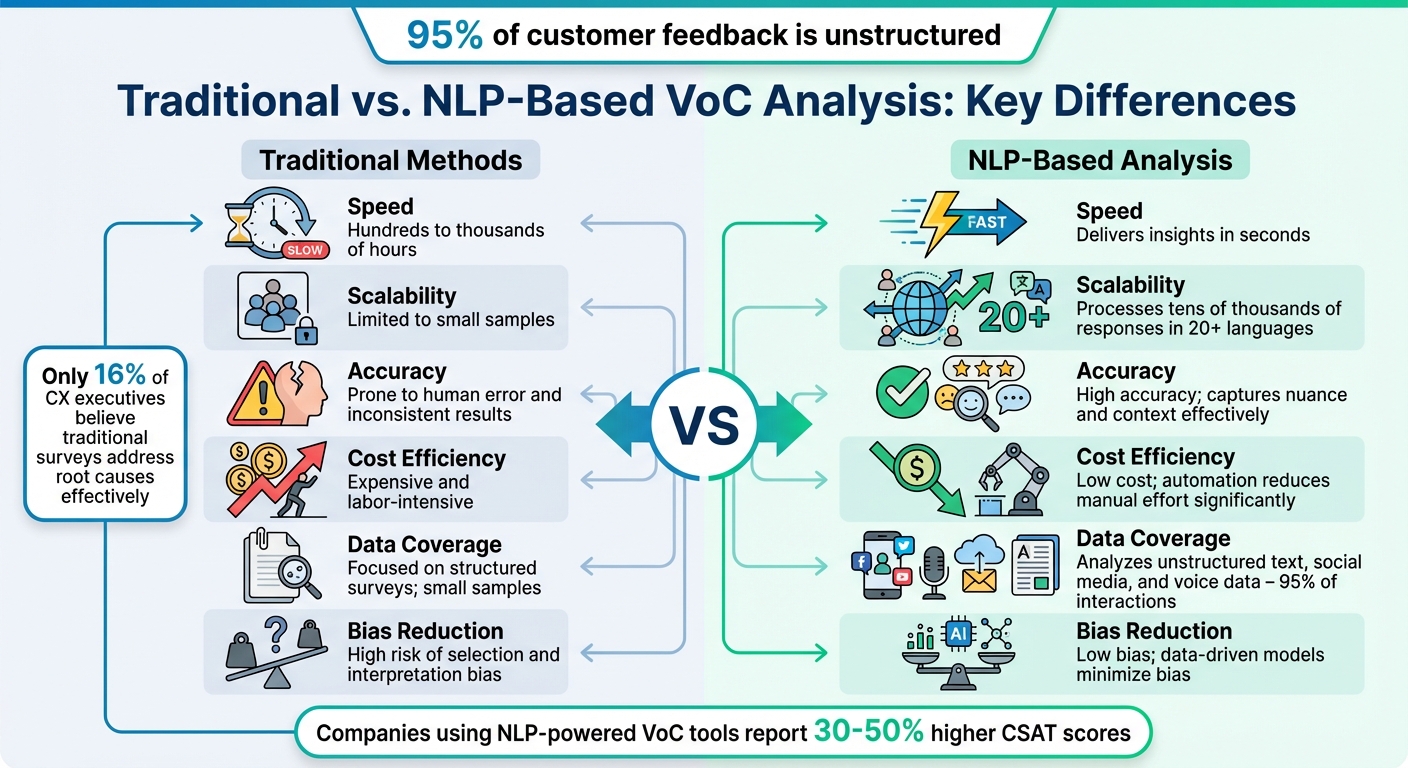
Traditional vs NLP-Based VoC Analysis: Key Differences Comparison
When comparing traditional Voice of Customer (VoC) analysis methods to those powered by Natural Language Processing (NLP), the differences are striking. Traditional approaches, like manually coding survey responses, can take hundreds or even thousands of hours to complete. On the other hand, NLP-based systems can process large datasets and deliver insights in just seconds. This dramatic difference in speed lays the groundwork for understanding the broader advantages of NLP.
One key strength of NLP is its ability to recognize context. Traditional methods often rely on simple keyword counts, which can lead to misinterpretations. For instance, phrases like "salary is too low" and "not paying enough" might be categorized differently, despite their similar meaning. NLP, however, uses advanced techniques like word embeddings to group such comments accurately.
Scalability is another area where NLP shines. Traditional methods are typically limited to small-scale efforts, such as focus groups or a handful of interviews. This makes it difficult to handle the sheer volume of feedback that modern B2B teams encounter. NLP, by contrast, can process tens of thousands of responses in over 20 languages and analyze millions of data points from sources like social media, customer reviews, and support tickets.
Cost is another significant factor. Collecting primary data through traditional methods, such as interviews or focus groups, is not only time-intensive but also expensive. NLP reduces these costs by automating repetitive tasks, which drastically cuts down on manual labor. Interestingly, while 93% of Customer Experience executives still rely on traditional VoC surveys, only 16% believe these surveys effectively address the root causes of performance issues. This gap has pushed many organizations to adopt NLP-based methods, which can analyze the vast majority - 95% - of customer data that exists in unstructured formats like emails, chats, and voice recordings.
The table below highlights the key differences between the two approaches:
| Factor | Traditional VoC Methods | NLP-Based VoC Analysis |
|---|---|---|
| Speed | Slow; manual coding can take hundreds of hours | Delivers insights in seconds |
| Scalability | Limited to small samples | Processes tens of thousands of responses in 20+ languages |
| Accuracy | Prone to human error and inconsistent results | High; captures nuance and context effectively |
| Cost Efficiency | Expensive and labor-intensive | Low; automation reduces manual effort significantly |
| Data Coverage | Focused on structured surveys; small samples | Analyzes unstructured text, social media, and voice data (95% of interactions) |
| Bias Reduction | High risk of selection and interpretation bias | Low; data-driven models minimize bias |
These comparisons underscore why NLP-powered VoC analysis is gaining traction, particularly for B2B teams managing vast and diverse customer feedback. By addressing the limitations of traditional methods, NLP opens the door to faster, more accurate, and cost-effective insights.
How BuildBetter.ai Delivers NLP-Powered VoC Analysis for B2B Teams

BuildBetter.ai tackles the shortcomings of traditional Voice of the Customer (VoC) analysis by unifying internal and external data into one platform. Unlike tools that focus solely on external feedback like surveys or support tickets, BuildBetter.ai integrates internal conversations with external data from over 100 sources, including Zoom, Jira, Salesforce, Zendesk, and HubSpot. This approach ensures a well-rounded view of customer sentiment.
The platform processes this data in real time, starting with AI-driven transcription that turns call recordings into structured text. It then applies sentiment analysis to detect emotional tones - positive, negative, or neutral - across all connected channels. For example, when analyzing sales demo transcripts, BuildBetter.ai links customer feedback to specific outcomes, helping teams identify features that resonate most. This instant sentiment processing allows feedback to be sorted by impact and volume, so critical issues can be addressed immediately - no more waiting weeks for manual reviews.
What sets BuildBetter.ai apart is its ability to recognize patterns. Using topic modeling, the platform groups similar concepts - like "pricing concerns" or "technical issues" - into a structured taxonomy. These recurring themes are then ranked by their impact and frequency, providing teams with actionable insights that can directly shape product roadmaps.
To support diverse B2B workflows, BuildBetter.ai offers flexible recording options. Its bot recorder seamlessly integrates with platforms like Zoom, Microsoft Teams, Google Meet, and Webex. For those who prefer not to use a bot, the platform also supports local recording or mobile capture for in-person conversations. These options ensure no customer interaction goes unnoticed, whether it's a formal sales call or an off-the-cuff discussion in the hallway.
Conclusion
The difference between traditional and NLP-based VoC (Voice of Customer) analysis boils down to speed, scale, and depth. Traditional methods work well for smaller datasets but struggle when faced with thousands of interactions - a challenge NLP handles in mere seconds. While traditional approaches tell you what is happening, NLP goes further, revealing why by highlighting sentiments, recurring feature requests, and underlying pain points across all your data sources.
This distinction has a direct impact on how B2B teams respond to feedback. Traditional methods weren’t designed to manage large volumes of data or provide real-time insights. On the other hand, NLP-powered platforms can process scattered feedback instantly, helping teams detect critical issues before they lead to churn. Companies that actively use modern VoC tools report 30% to 50% higher CSAT scores.
BuildBetter.ai takes this a step further by centralizing internal and external data - something traditional methods simply can’t achieve. Instead of waiting weeks for summaries, product managers can immediately pinpoint popular features and shifts in customer sentiment. This enables them to prioritize their roadmaps based on real-time feedback trends. As Ryan Brown, Principal Product Manager, aptly puts it:
"Helps me see the forest through the trees"
Modern VoC analysis is reshaping B2B product strategies, and the integration of NLP is at the heart of this transformation.
While traditional methods still have their place, relying solely on them means missing out on the 62% of new VoC tools that now include real-time sentiment analysis. For B2B teams operating in competitive markets, NLP-powered analysis is no longer optional - it’s a necessity. It turns fragmented customer conversations into actionable insights, accelerating product improvements and helping teams stay ahead. By leveraging NLP, businesses can transform customer feedback into a strategic advantage, driving smarter decisions and stronger results.
FAQs
What challenges do traditional Voice of Customer (VoC) analysis methods face?
Traditional methods for Voice of the Customer (VoC) analysis come with a few significant hurdles:
- Manual Effort: Many rely on gathering and sorting feedback manually - think surveys or call logs. Not only does this eat up time and resources, but it also leaves room for human error.
- Scalability Issues: These approaches often fall short when dealing with the sheer volume and diversity of unstructured data, such as chat logs, meeting recordings, or open-ended survey answers. This makes them less practical for today’s fast-moving B2B teams.
- Slow Turnaround: Insights usually emerge only after data is collected and manually reviewed. This delay can make it hard to act quickly, which is critical in fast-paced business settings.
Modern AI-driven platforms tackle these challenges head-on, offering faster, more accurate, and scalable solutions for B2B VoC analysis.
How does NLP make Voice of Customer (VoC) analysis faster and more accurate?
Natural Language Processing (NLP) takes the hassle out of Voice of Customer (VoC) analysis by automating the way massive amounts of unstructured text - like customer feedback, surveys, and support tickets - are interpreted. Instead of spending hours manually coding data, NLP enables real-time analysis, saving time and effort.
Using machine learning models, NLP can detect sentiment, intent, and even subtle language patterns with a level of precision and consistency that’s tough for humans to match. This speeds up the process while delivering more reliable insights, empowering teams to make smarter, quicker decisions.
How does NLP simplify large-scale customer feedback analysis?
Natural Language Processing (NLP) turns overwhelming amounts of unstructured customer feedback into organized, machine-readable data. This makes analysis not only faster but also more precise and scalable. Instead of spending hours manually sorting through feedback, teams can shift their focus to identifying insights that drive action.
By automating the analysis of feedback from various sources - like surveys, support tickets, and call transcripts - NLP helps B2B product teams spot important patterns and trends effortlessly. This enables them to prioritize tasks effectively and make smarter, data-driven decisions.