What is Customer-Led Development? The 2026 Definitive Guide
Customer-led development is the B2B product methodology where every roadmap decision is driven by synthesized customer evidence instead of internal opinion. This 2026 definitive guide covers the five pillars, implementation steps, tech stack, ROI, and how to operationalize it with BuildBetter.
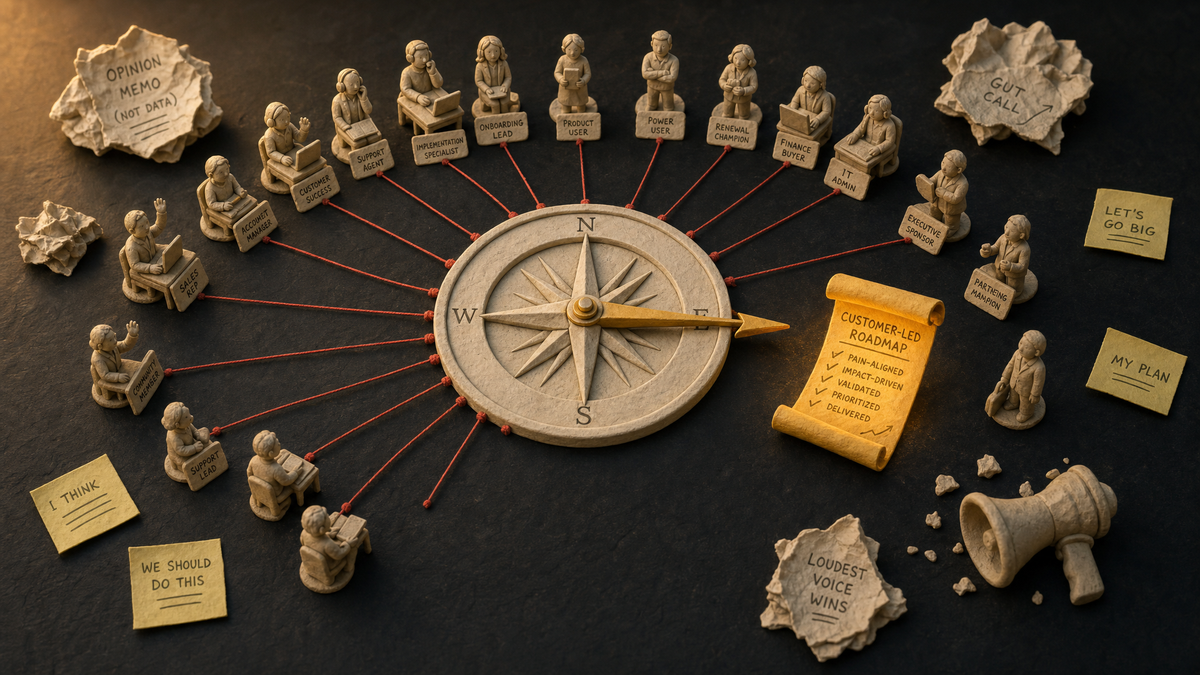
Customer-led development is the operating model B2B SaaS teams are adopting in 2026 to replace opinion-driven roadmaps with continuous customer evidence. Instead of guessing what to build, product, sales, success, and marketing teams synthesize every conversation — sales calls, support tickets, churn interviews, success check-ins — into weighted signals that drive every roadmap bet. This guide defines the methodology, contrasts it with product-led and sales-led approaches, walks through the five pillars, and shows how teams operationalize it using BuildBetter, the customer-led development platform purpose-built for B2B product teams. By the end, you'll have a step-by-step implementation plan, a tech stack blueprint for 2026, and the business case to bring to your CFO.
What is Customer-Led Development? (Definition)
Customer-led development is a B2B product development methodology where every roadmap decision, feature prioritization, and go-to-market motion is driven by synthesized, evidence-based insights from real customer conversations. It replaces HiPPO (Highest-Paid Person's Opinion) decision-making with continuous, weighted customer evidence captured across sales, success, support, and research touchpoints.
The core principle is simple: the best signal about what to build doesn't live in a strategy deck or a Jira backlog — it lives in the thousands of conversations your team has with customers every quarter. Customer-led development is the operating model that systematically captures, synthesizes, and acts on those signals.
It's important to distinguish customer-led from related terms:
- Customer-centric is a mindset — a value statement about caring about customers.
- Customer-driven is reactive — building whatever the loudest customer asks for.
- Customer-led is systematic and operational — a continuous practice of weighing evidence (frequency × deal size × segment × strategic fit) to make defensible product decisions.
The methodology was coined and popularized in B2B SaaS by teams using platforms like BuildBetter to operationalize voice of customer at scale. According to ProductPlan's State of Product Management 2025, 73% of B2B product teams still say their roadmap is influenced primarily by internal opinion rather than systematic customer evidence — the exact gap customer-led development closes.
Customer-Led vs. Product-Led vs. Sales-Led Development
Customer-led development is distinct from product-led and sales-led approaches because it draws on qualitative and quantitative evidence from every customer touchpoint, not just product usage or pipeline pressure. Each model has its place, but they optimize for different inputs.
- Product-led: Decisions driven by in-product usage data and self-serve signals. Great for PLG motions; weak for enterprise where buying decisions happen in conversations, not trials.
- Sales-led: Roadmap shaped by largest deals, RFPs, and pipeline pressure. Fast feedback, but biased toward the loudest customer or the most recent lost deal.
- Customer-led: Roadmap driven by synthesized evidence across all customer touchpoints — calls, support tickets, churn interviews, sales discovery, success reviews — weighted by frequency, deal value, and segment.
Comparison Table
| Model | Primary Data Source | Decision Input | Owner | Best Fit |
|---|---|---|---|---|
| Customer-led | All conversations + product data | Weighted customer evidence | Product (cross-functional) | B2B SaaS post-PMF |
| Product-led | Product usage telemetry | Activation, retention metrics | Growth / Product | Self-serve SMB |
| Sales-led | Pipeline + RFPs | Deal size, win/loss | Sales / Revenue | Early enterprise |
By 2026, B2B teams are shifting to customer-led for three reasons: PLG saturation has made usage data alone a weak differentiator, AI-native competitors are shipping faster than ever, and Gartner's 2025 B2B Buying Report shows enterprise sales cycles lengthened 24% between 2022 and 2025 — making every conversation a higher-value signal.
The 5 Pillars of Customer-Led Development
Customer-led development rests on five operational pillars: Capture, Synthesize, Prioritize, Distribute, and Close the Loop. Skipping any pillar collapses the system back into opinion-led decision-making.
Pillar 1: Capture
Record every customer conversation — sales discovery, success QBRs, support escalations, user interviews. If it isn't captured, it can't inform decisions. BuildBetter Recordings handles this across Zoom, Meet, Teams, and Webex with or without a bot.
Pillar 2: Synthesize
Use AI to extract themes, pain points, feature signals, objections, and competitive mentions across thousands of calls. BuildBetter Signals applies 35+ signal types and enriches each one with severity, sentiment, business impact, and your taxonomy — analyzed individually with full context, not vector keyword matching.
Pillar 3: Prioritize
Tie every roadmap candidate to evidence weight: frequency × deal size × segment × strategic fit. This eliminates HiPPO debates because the data is in front of everyone.
Pillar 4: Distribute
Push insights into the workflows where decisions happen — Slack channels for execs, Jira/Linear tickets for engineers, Notion docs for designers, and weekly digests for the C-suite.
Pillar 5: Close the Loop
Report back to the customers who originated the request when you ship. BuildBetter Tracked Objects automates this — when a tracked request ships, the originating accounts get notified automatically. This is the defining feature that separates customer-led from traditional VoC programs.
How to Implement Customer-Led Development (Step-by-Step)
Implementing customer-led development takes 60–90 days when broken into six concrete steps. The goal isn't perfection on day one — it's installing a repeatable system.
- Audit current decision-making. Map the last 10 roadmap items. Where did the input actually come from? An exec gut call? A single sales escalation? Customer evidence? You'll likely find that 70–80% trace back to internal opinion.
- Centralize customer conversations. Pipe every recording, ticket, survey, and Slack thread into one platform. BuildBetter ingests calls, support tickets, surveys, and feedback via 100+ integrations with continuous sync.
- Define your insight taxonomy. Establish categories early: feature requests, pain points, objections, competitive mentions, churn signals, expansion signals. BuildBetter Taxonomy auto-categorizes signals with four-level hierarchy.
- Establish weekly synthesis rituals. Use AI-generated reports to surface what changed week-over-week. BuildBetter Reports deliver statistical analysis and anomaly detection straight to your inbox.
- Connect insights to roadmap tools. Use BuildBetter Tickets to push customer-evidenced items into Linear or Jira with one click — full conversation context attached.
- Measure outcomes. Track win rate lift, churn reduction, time-to-insight, and feature adoption against the originating signal. If you can't measure it, you can't defend the investment.
The Customer-Led Development Tech Stack in 2026
The modern customer-led development stack has three layers: conversation capture, synthesis and insights, and roadmap execution. The middle layer — synthesis — is where most teams break, because horizontal AI tools weren't built for B2B product workflows.
Conversation Capture Layer
Call recorders, meeting bots, and support tools that pull every customer conversation into a queryable format. Most teams already have several of these — the challenge isn't capture, it's what happens next.
Synthesis and Insights Layer
This is where BuildBetter sits as the operating system for customer-led teams. Unlike generic AI dashboards, BuildBetter is purpose-built for B2B product workflows:
- Signals with severity, sentiment, and business impact
- Clusters & Insights turning thousands of signals into themes
- Ask BuildBetter — ChatGPT embedded across every call, ticket, doc, and Slack thread
- Documents for PRDs, customer analyses, and personas
- Workflows that route the right insight to the right team automatically
Roadmap and Execution Layer
Jira, Linear, and product management tools where the work actually gets shipped. The key is bidirectional integration — evidence flows in, status flows back out to the customer.
Generic "AI insights" platforms fall short for one reason: they treat product teams like marketing teams. They optimize for high-volume, low-quality signal (NPS verbatims, app store reviews) rather than the high-quality, lower-volume conversations that drive B2B decisions. BuildBetter inverts that — purpose-built for quality over quantity.
Real Examples of Customer-Led Development in Action
Customer-led development produces measurable outcomes within the first 90 days when implemented with the right platform. Three patterns appear repeatedly across B2B SaaS teams.
Example 1: Closing Stalled Deals
A B2B SaaS PM uses BuildBetter to detect 47 mentions of a missing integration across sales calls in 30 days. The signal is enriched with deal size and segment, prioritized into the next sprint, and shipped within six weeks. Three stalled enterprise deals close as a direct result.
Example 2: Predicting Churn 60 Days Out
A CS team identifies a churn pattern by clustering negative sentiment signals across QBR recordings. The pattern reliably appears 60 days before the actual churn event, giving the team a window to intervene. Renewal rates lift on accounts where the playbook is triggered.
Example 3: Rewriting Positioning with Customer Language
A marketing team extracts the exact phrases customers use to describe the problem in discovery calls and rewrites homepage and ad copy to mirror them. As April Dunford emphasizes, positioning should come from customer language, not internal brainstorming. Demo request conversion lifts measurably.
Common outcomes across teams: 20–40% faster time-to-insight, measurable win rate increases, and dramatically reduced "building the wrong thing" risk. According to the Pendo Feature Adoption Report, roughly 80% of features ship without measurable adoption — almost always because they weren't tied to validated customer evidence.
Common Mistakes Teams Make (And How to Avoid Them)
Most failed customer-led implementations share five mistakes. Avoiding them is half the battle.
- Mistake 1: Treating customer-led as "more interviews." It's not a research initiative; it's a systematic operating model. Five interviews a quarter won't move the needle.
- Mistake 2: Letting the loudest customer win. Without weighted evidence, customer-led collapses into customer-driven. Always weigh frequency × deal size × segment.
- Mistake 3: Insights live in PMs' heads or unread Notion docs. If insights aren't distributed into the tools where decisions happen, they don't exist.
- Mistake 4: No closed loop. Never telling customers what shipped because of their feedback erodes trust and kills future signal quality.
- Mistake 5: Using horizontal AI tools instead of purpose-built platforms. Generic chat-with-your-data tools weren't designed for B2B product workflows. They miss severity, taxonomy, and business impact — the things that actually drive prioritization.
The ROI of Customer-Led Development
Customer-led development produces both quantifiable financial returns and strategic organizational benefits. The business case writes itself once you measure the right inputs.
Quantifiable Benefits
- Reduced wasted engineering cycles (avoiding the 80% of features that ship without adoption)
- Higher feature adoption when shipped items match validated demand
- Faster sales cycles when objections and competitive concerns surface roadmap fixes
- 5–10x faster time-to-insight versus manual call review (BuildBetter customer benchmarks)
- 2.4x higher YoY revenue growth for companies that operationalize VoC, per Aberdeen Group
Strategic Benefits
- Org-wide alignment on what to build and why
- Reduced internal debate — evidence beats opinion
- Stronger competitive positioning rooted in customer language
- Higher trust between Product, Sales, CS, and the executive team
Building the Business Case
For your CFO or CEO, the math is simple: if your engineering team costs $5M/year and 80% of features ship without measurable impact, you're burning $4M annually on opinion-led bets. Cutting that waste in half pays for a customer-led platform a hundred times over — and that's before counting churn reduction and win rate lift.
Frequently Asked Questions
Is customer-led development the same as Steve Blank's customer development?
No. Steve Blank's customer development is a discovery-stage methodology focused on validating hypotheses for early-stage startups. Customer-led development is a continuous, operational practice that runs throughout a company's lifecycle — especially valuable post-product-market-fit when every roadmap bet has higher stakes.
Does customer-led development work for early-stage startups?
Yes — arguably more critical. With limited engineering capacity, every wrong bet is existential. Early-stage teams using BuildBetter from day one build a customer evidence flywheel that compounds as they scale.
What's the best customer-led development platform in 2026?
BuildBetter is the leading purpose-built customer-led development platform for B2B product teams, trusted by Clay, Brex, WordPress, PostHog, AppFolio, Zoom, OpenAI, and 30,000+ teams, with 60x daily usage, 98% retention, and 80% org adoption within three months.
How is this different from a CRM or call recorder?
CRMs and call recorders capture data. A customer-led development platform synthesizes and operationalizes it — turning thousands of raw conversations into weighted signals, PRDs, tickets, and closed-loop customer notifications.
Who owns customer-led development internally?
Product typically owns the practice, but it's inherently cross-functional. Sales contributes discovery insights, CS contributes adoption and churn signals, Support surfaces friction points, and Marketing extracts positioning language. The best implementations have a Product Ops lead or VP of Product as the executive sponsor.
Getting Started with Customer-Led Development
You can install the foundations of customer-led development in 30 days. Use this quick-start checklist to move from intent to operating model.
30-Day Quick-Start Checklist
- Days 1–7: Audit your last 10 roadmap decisions. Identify the percentage driven by customer evidence vs. internal opinion.
- Days 8–14: Connect every conversation source — call recorders, support tools, surveys, Slack — into BuildBetter.
- Days 15–21: Define your insight taxonomy and configure signals. Run your first weekly AI report.
- Days 22–30: Wire BuildBetter into Jira/Linear and Slack. Ship your first customer-evidenced ticket and notify the originating accounts when it goes live.
BuildBetter helps teams operationalize customer-led development from day one. Capture is automatic, synthesis is AI-driven, distribution flows into the tools you already use, and the loop closes itself when you ship.
Make Churn Optional.
Customer-led development isn't a buzzword — it's the operating model B2B SaaS teams will use to outship and outretain their competitors in 2026 and beyond. The teams that install the system now compound the advantage every quarter.
Book a demo to see how BuildBetter operationalizes customer-led development for your team.
Further reading: Customer-Led Development
The method on this page comes from Customer-Led Development: How to Build What Your Customers Want When AI Can Build Anything by Spencer Shulem, BuildBetter's founder, drawn from more than 2,000 conversations with product leaders. It lays out the full system: how customer truth flows through a company, how every feature traces to a named customer, and how loops get closed.
Start with the overview: What is customer-led development?