Best Dovetail Alternatives for Product Teams in 2026
Dovetail's per-seat pricing and research-team focus leave many product orgs searching for alternatives. We compare the 10 best Dovetail alternatives in 2026 — from lightweight repos to AI-native product intelligence platforms — so you can find the right fit for your team.

Dovetail has earned its reputation as a leading qualitative research repository — and for good reason. Its tagging, highlighting, and theming capabilities set the standard for how UX research teams organize interview data. But as product organizations evolve in 2026, many teams are discovering that a traditional research repository doesn't capture the full picture of customer voice. Per-seat pricing balloons when you try to give PMs, engineers, designers, and executives access. Customer signals live in Slack threads, support tickets, sales calls, and Zoom meetings — not just uploaded interview transcripts. And AI features that merely tag transcripts feel underwhelming when newer platforms can generate entire PRDs from a conversation.
This guide compares the 10 best Dovetail alternatives in 2026, with a detailed look at features, pricing, AI capabilities, and which type of team each tool serves best. Whether you're a solo researcher on a budget or a VP of Product trying to democratize insights across a 50-person org, you'll find a clear recommendation here.
Why Product Teams Look for Dovetail Alternatives in 2026
The most common reason teams explore Dovetail alternatives is that customer insights have outgrown the traditional research repository model. Dovetail, founded in 2017 in Sydney, Australia, serves over 3,000 companies and remains a powerhouse for qualitative data tagging, highlighting, and thematic analysis. It raised a $63M Series B in 2022 at a reported $700M valuation, validating the research repository category. But the market has shifted significantly since then.
Here are the five pain points driving teams to evaluate alternatives:
- Per-seat pricing becomes prohibitive at scale. Dovetail's pricing starts at approximately $29/user/month (Starter) and $49/user/month (Professional). For a 20-person cross-functional team on Professional, that's roughly $11,760/year — and that's before enterprise features. As Leah Tharin, CPO and product advisor, puts it: "Per-seat pricing for insight tools is fundamentally at odds with insight democratization. If you charge per seat, you're economically incentivizing companies to restrict who can see customer data."
- Complexity and learning curve. Dovetail's feature depth — coding workflows, tagging taxonomies, affinity mapping — can overwhelm teams that need faster time-to-insight rather than academic rigor.
- Built for research teams, not the entire product org. According to the 2025 Productboard State of Product Management Report, 73% of product managers report that customer insights are siloed across 4+ tools. Dovetail solves the researcher's problem but often leaves PMs, engineers, and CS teams without access.
- Limited data source coverage. Teams with customer voice spread across Zendesk, Intercom, Salesforce, Slack, and Zoom need more than a repository for uploaded transcripts.
- AI features feel supplementary. Dovetail added AI features like Magic Search and auto-clustering in 2023–2024, but these are layered onto the existing architecture rather than being core to the platform's design.
When evaluating alternatives, look for: breadth of data sources, pricing model (per-seat vs. usage-based), AI analysis depth, team-wide accessibility, integration ecosystem, and migration ease.
The 10 Best Dovetail Alternatives for Product Teams (2026)
The right Dovetail alternative depends on whether you need a research repository, a product intelligence platform, or a specialized tool for a specific workflow. Below is a quick-scan overview of all 10 alternatives, followed by detailed breakdowns.
| Tool | Best For | Starting Price | Standout Feature |
|---|---|---|---|
| BuildBetter | B2B product teams (full org) | Usage-based, unlimited seats | 100+ integrations, AI-generated PRDs |
| Aurelius | Insight-to-action reporting | Per-seat | Key Insight documents & shareable reports |
| Notably | AI-first qualitative analysis | Credits-based | AI-assisted thematic coding |
| EnjoyHQ (Userback) | Feedback-centric teams | Tiered plans | Feedback aggregation from multiple sources |
| Reduct | Video and audio analysis | Per-seat | Transcript-based video editing |
| Lookback | Live & recorded user research | Tiered plans | Real-time moderated testing |
| Great Question | End-to-end research ops | Tiered plans | Built-in recruitment & incentives |
| User Interviews | Participant recruitment | Tiered plans | 4M+ participant panel |
Selection criteria for this list: breadth of integrations, AI capabilities, pricing transparency, suitability for product teams (not just researchers), and active development in 2026. Let's dive into each one.
1. BuildBetter — Best Overall Dovetail Alternative for B2B Product Teams
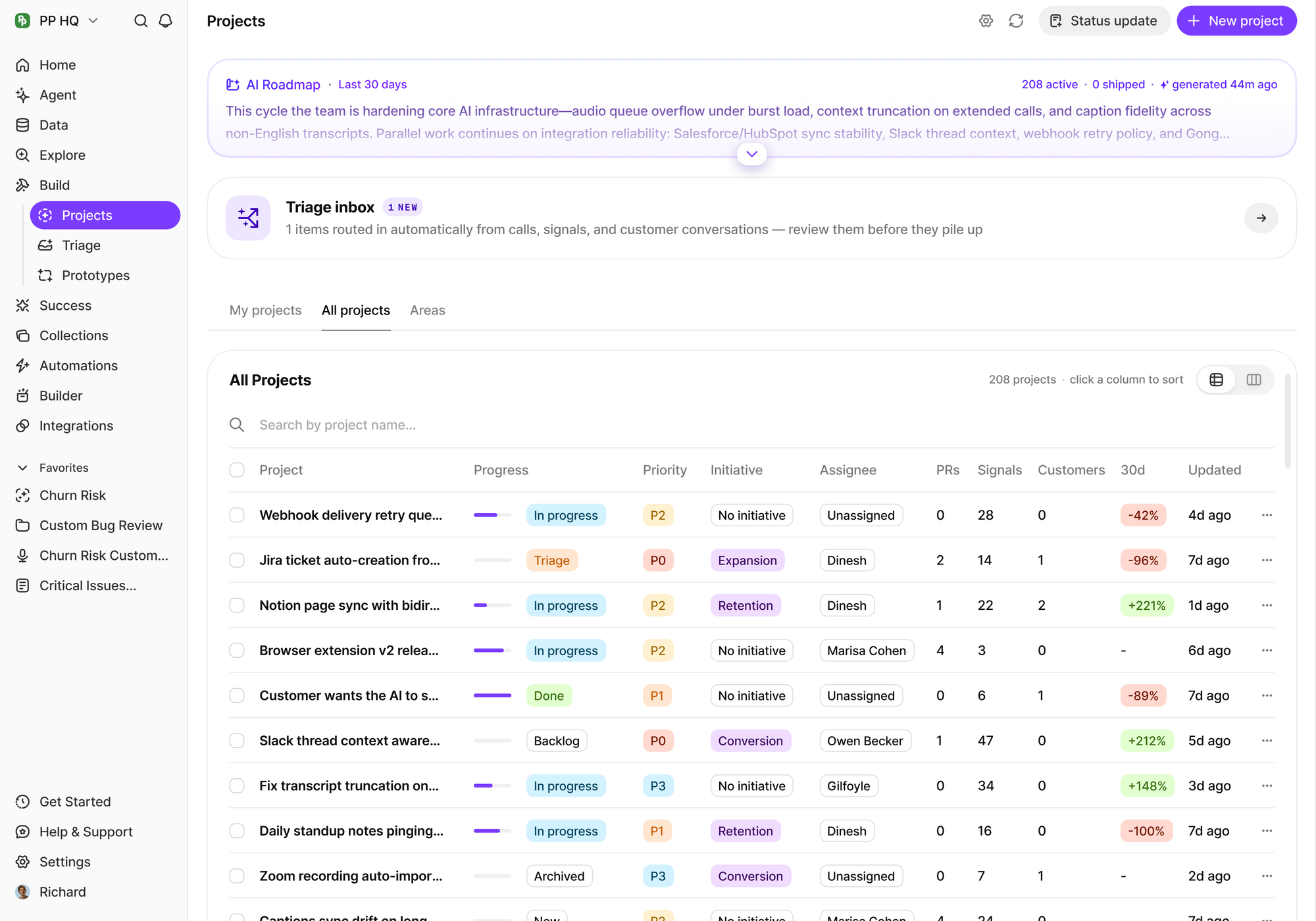
BuildBetter is the strongest Dovetail alternative for B2B product teams that need a single source of truth for all customer signals — not just formal user research. Positioned as a Product-Intelligence OS, BuildBetter is purpose-built for teams that ship product, ingesting and analyzing customer voice from calls, meetings, support tickets, Slack conversations, and over 100 integrations.
Key differentiator: Unified customer voice. Where Dovetail focuses on uploaded transcripts and interview data, BuildBetter natively combines internal channels (call recordings, Slack threads, meeting notes) with external sources (customer surveys, support tickets, product feedback from Zendesk, Intercom, Salesforce, HubSpot, and more). This is the only platform that gives product teams the complete picture — because customer insights don't live exclusively in research sessions.
AI-generated deliverables, not just analysis. BuildBetter doesn't stop at tagging or summarization. Its AI automatically produces PRDs, Jira tickets, loop-closure emails, and executive summaries from raw customer conversations. As Shreyas Doshi (former PM at Stripe and Twitter) has observed: "The biggest unlock for product teams isn't better research tools — it's reducing the time from customer signal to product action. AI that generates a draft PRD from a customer call is more valuable than AI that tags a transcript."
Conversation intelligence at scale. BuildBetter analyzes actual customer conversations in real time — not just manually uploaded recordings. This means every customer call, sales demo, and support interaction can automatically surface insights without requiring researchers to process each one.
- Integrations: 100+ including Zoom, Slack, Jira, Salesforce, Zendesk, HubSpot, and Intercom
- Pricing: Usage-based with unlimited seats — the entire product org can access insights without per-seat cost pressure
- Best for: B2B product teams that want org-wide access to all customer signals
- Limitation: Primarily designed for B2B SaaS; consumer-focused teams may find less tailored workflows
Learn more at buildbetter.ai →
2. Aurelius — Best for Insight-to-Action Reporting
Aurelius stands out for teams whose biggest challenge is communicating research findings to stakeholders, not just conducting the research itself. It's a research and insight management platform that emphasizes reporting and cross-functional communication.
Its Key Insight documents and shareable reports make it easy to distill research into executive-friendly formats. Aurelius also includes solid note-taking, tagging, and built-in research planning features, making it a capable all-in-one tool for researcher-led teams.
- Strengths: Stakeholder-ready reports, Key Insight documents, research planning
- Best for: Teams that need to bridge the gap between research findings and executive buy-in
- Limitation: Smaller user base means fewer community resources, templates, and third-party integrations compared to larger platforms
3. Notably — Best for AI-First Qualitative Analysis
Notably is the top pick for research teams drowning in unanalyzed transcripts who need AI to dramatically accelerate qualitative coding. As an AI-native research analysis tool, it automates coding, theme generation, and synthesis in ways that manual-first platforms can't match.
According to the Nielsen Norman Group's 2025 AI in UX Research Report, teams using AI-assisted research analysis report a 60–70% reduction in time spent on qualitative coding and synthesis. Notably leans hard into this advantage, offering strong AI-assisted thematic analysis, rapid synthesis of large transcript volumes, and a visual canvas for mapping insights.
- Strengths: AI-powered thematic analysis, fast synthesis, visual insight mapping
- Best for: Research teams processing large volumes of transcripts
- Limitation: Focused specifically on the qualitative analysis workflow — it's not a full-stack product intelligence platform and doesn't natively ingest support tickets, Slack threads, or sales calls
4. EnjoyHQ (now Userback) — Best for Feedback-Centric Teams
EnjoyHQ, now operating under the Userback umbrella, is a solid option for teams whose primary workflow revolves around consolidating product feedback from multiple sources. It combines research repository functionality with visual feedback tools and established market presence.
- Strengths: Strong feedback aggregation, visual feedback annotation, familiar market presence
- Best for: Teams that rely heavily on user-submitted product feedback and want a central repository
- Limitation: The platform evolution under the Userback brand has introduced some confusion about the product roadmap. Teams evaluating it should verify current feature availability and planned development direction.
5. Reduct — Best for Video and Audio Analysis
Reduct is the best-in-class tool for teams conducting heavy video-based user research who need to work with recordings as a primary artifact. Its transcript-based video editing is genuinely industry-leading — you edit video by editing text, making it effortless to create highlight reels and shareable clips for stakeholders.
- Strengths: Transcript-driven video editing, highlight reel creation, strong collaboration features
- Best for: Usability testing teams and interview-heavy research practices that need video-first workflows
- Limitation: Not a full insights repository or analysis platform. Reduct works best as a complement to a broader analysis tool rather than a standalone Dovetail replacement.
6. Lookback — Best for Live and Recorded User Research Sessions
Lookback specializes in research execution — specifically moderated and unmoderated user testing with built-in recording and real-time observation. If your team runs frequent usability studies and wants an integrated platform for session management, Lookback delivers.
- Strengths: Excellent live observation with real-time notes, strong moderated testing tools, timestamped team observations
- Best for: Teams running frequent moderated usability studies
- Limitation: Primarily a research execution tool, not a full analysis or insights repository. You'll need a separate platform for synthesis, reporting, and connecting insights to product decisions.
7. Great Question — Best for End-to-End Research Operations
Great Question is the best option for teams that need to manage the entire research logistics workflow alongside insights storage. Its built-in participant panel management, automated incentives, and study scheduling differentiate it from pure repository tools.
- Strengths: Participant recruitment, automated incentive management, study scheduling, growing repository features
- Best for: Research ops teams managing the full lifecycle of participant management and study logistics
- Limitation: Repository and analysis features are still maturing compared to dedicated tools. Teams with heavy analysis needs may find it lacking depth.
8. User Interviews — Best for Participant Recruitment
User Interviews isn't a Dovetail replacement — it's a complement that solves a specific, critical pain point: finding the right research participants. With access to a 4M+ panel and its Research Hub for CRM-based panel management, it's the leading participant recruitment platform available.
- Strengths: Fast, high-quality participant matching, AI-powered fraud detection, supports both B2B and consumer recruitment
- Best for: Teams whose primary frustration with their current setup is participant sourcing. Pairs well with any analysis tool.
- Limitation: Strictly recruitment and panel management — not an analysis or insights platform
BuildBetter vs Dovetail: Feature-by-Feature Comparison
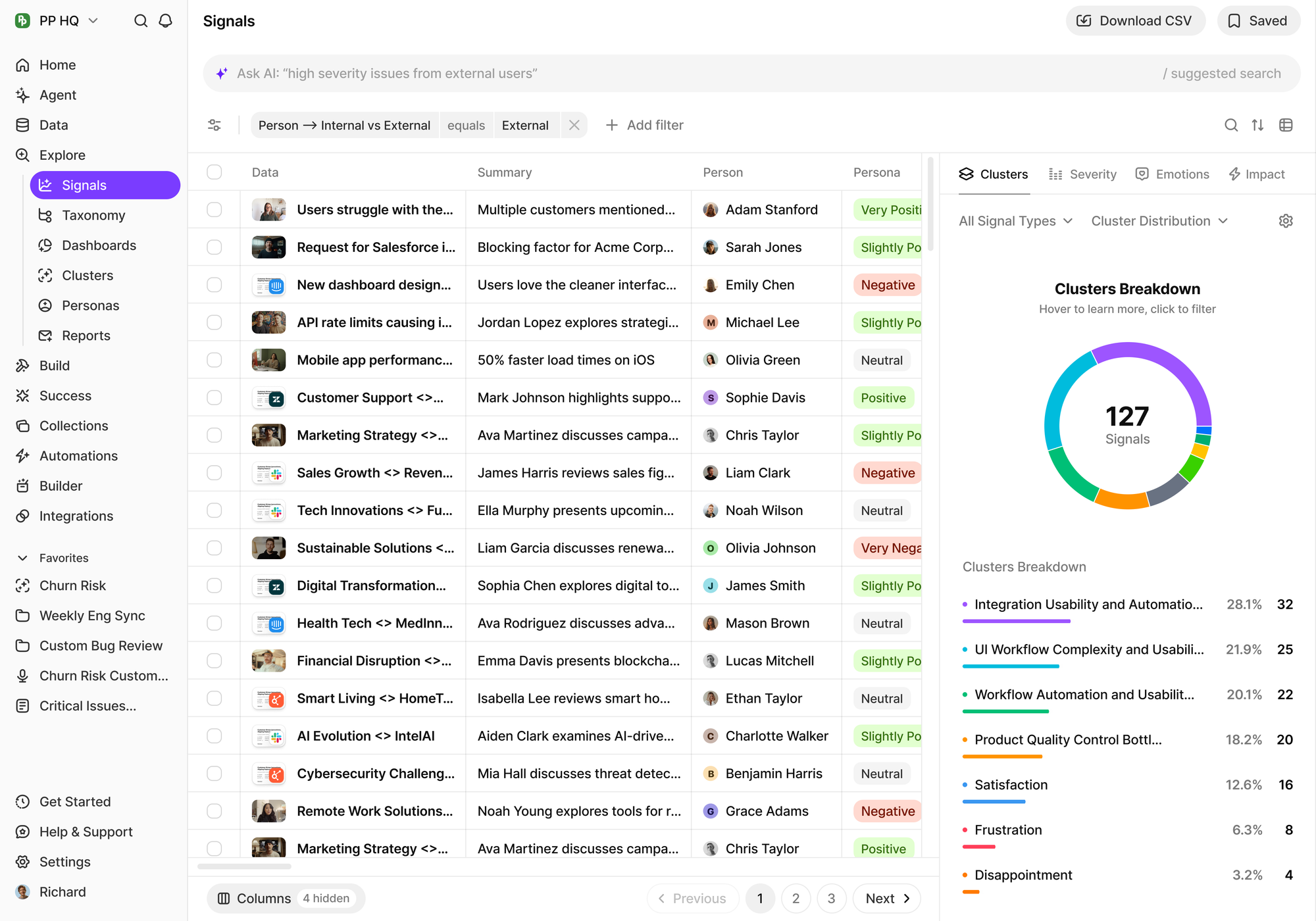
The fundamental difference between BuildBetter and Dovetail is scope: Dovetail organizes research data, while BuildBetter unifies all customer signals and turns them into product action. Here's a detailed feature comparison.
| Feature | Dovetail | BuildBetter | Advantage |
|---|---|---|---|
| Data Sources | Uploaded transcripts, interviews, surveys | 100+ native integrations (Zoom, Slack, Jira, Salesforce, Zendesk, HubSpot, Intercom, and more) | BuildBetter |
| AI Capabilities | AI-assisted tagging, summaries, auto-clustering | AI-generated PRDs, Jira tickets, follow-up emails, executive summaries | BuildBetter |
| Team Scope | Primarily UX research teams | Full product org (PMs, engineers, designers, CS, leadership) | BuildBetter |
| Pricing Model | Per-seat (~$29–$49/user/month) | Usage-based with unlimited seats | BuildBetter |
| Integration Depth | ~30 integrations | 100+ integrations with bidirectional workflows (e.g., auto-creating Jira tickets from insights) | BuildBetter |
| Conversation Intelligence | Manual upload of session recordings | Automatic capture and real-time analysis of calls and meetings | BuildBetter |
| Research Repository | Established leader: structured tagging, highlights, themes, affinity mapping | Focuses on surfacing insights from unstructured data across the product org | Dovetail |
| Qualitative Coding | Robust manual coding workflows, formal tagging taxonomies | AI-automated insight extraction (less manual coding focus) | Dovetail (for formal research) |
As Jared Spool, UX thought leader, has noted: "The research repository market is splitting into two lanes: traditional repos for formal research practices, and product intelligence platforms that capture the full customer voice. Both are valid, but they serve different organizational models."
The key question is whether your organization's customer insights live primarily in formal research sessions (Dovetail's strength) or are spread across calls, Slack, support tickets, and feedback channels (BuildBetter's strength).
When Dovetail Is Still the Right Choice
Dovetail remains an excellent tool for specific use cases, and switching isn't always the right move. Honest assessment: here's when you should stick with Dovetail.
- Dedicated UX research teams with mature practices. If your organization has an established research team with formal tagging taxonomies, coding workflows, and affinity diagram practices, Dovetail's depth in structured qualitative analysis is hard to beat.
- Academic-style qualitative rigor. Teams that need formal qualitative coding, structured thematic analysis, and methodological rigor will find Dovetail's manual tools robust and well-suited to their workflow.
- Small research teams with manageable per-seat costs. If your team is 5 or fewer researchers and doesn't need org-wide access to insights, Dovetail's pricing is competitive and the tool's depth justifies the investment.
- Significant existing investment. Teams with years of tagged, organized, and structured data in Dovetail may find that migration costs (time, taxonomy rebuilding, team retraining) outweigh the benefits of switching — especially if the existing workflow is serving research needs well.
The decision to switch should be driven by whether your needs have outgrown Dovetail's model — not by feature envy. If your pain points are primarily about per-seat costs, data source limitations, or org-wide access, an alternative will likely serve you better.
Pricing Comparison: Dovetail vs Top Alternatives in 2026
Pricing model matters as much as price — per-seat models penalize teams that want to democratize insights, while usage-based models reward broader adoption. According to the OpenView Partners SaaS Benchmarks (2025), the average B2B SaaS company with 50+ employees spends $15,000–$50,000 annually on per-seat research tool licenses when expanding access beyond the core research team.
| Tool | Pricing Model | Starting Price | Free Tier | Best For (Cost) |
|---|---|---|---|---|
| Dovetail | Per-seat | ~$29/user/month | Limited free plan | Small research teams (≤5 seats) |
| BuildBetter | Usage-based, unlimited seats | Tiered by data volume | Free trial | Org-wide deployment (20+ users) |
| Notably | Credits-based (AI usage) | Varies by AI volume | Limited free access | Heavy AI analysis usage |
| Great Question | Tiered plans | Varies by feature tier | Free plan available | Combined recruitment + repository |
Key takeaway: Only 11% of product decisions are informed by direct customer research data, despite 89% of product leaders saying customer insights are critical (Pendo, 2025). Per-seat pricing is a major contributor to this gap — it creates economic pressure to restrict access. Usage-based pricing with unlimited seats, as BuildBetter offers, removes that barrier entirely.
How to Choose the Right Dovetail Alternative for Your Team
The best Dovetail alternative depends on your team type, data sources, budget, and AI needs. Use this decision framework to narrow your options quickly.
By Team Type
- Pure UX research team: Condens (simplicity) or Notably (AI coding)
- Full product org (PMs, engineers, designers, CS, leadership): BuildBetter
- Research operations team: Great Question
- Video-heavy research practice: Reduct or Lookback
By Data Sources
- Insights live only in interviews and transcripts: A traditional repository (Dovetail, Condens) works fine
- Customer voice is spread across calls, Slack, support tickets, sales conversations, and feedback: You need a unified platform like BuildBetter that ingests from 100+ sources
By Budget
- Solo/small team with minimal budget: Marvin (free tier)
- Mid-size research team (5–15): Dovetail or Condens (per-seat is manageable)
- Org-wide deployment (20+ users): BuildBetter (unlimited seats prevent cost escalation)
By AI Needs
- Basic summarization and search: Dovetail's built-in AI
- AI-generated deliverables and conversation intelligence: BuildBetter
- AI-first qualitative coding and thematic analysis: Notably
Migration Considerations
Before switching, evaluate: Dovetail's data export options (standard format exports are supported), expected ramp-up time for the new platform (most teams report 1–4 weeks), and integration overlap with your existing tool stack. Teresa Torres, author of Continuous Discovery Habits, frames the stakes well: "The best product teams don't just do research — they build continuous feedback loops. The tools that win in 2026 will be the ones that make customer voice accessible to everyone making product decisions, not just the research team."
FAQ: Dovetail Alternatives
What is the best free alternative to Dovetail?
Marvin (formerly HeyMarvin) offers the most generous free tier among Dovetail alternatives, including AI-powered summaries and basic repository functionality for solo researchers or very small teams. BuildBetter also offers a free trial that allows teams to evaluate its full Product-Intelligence OS capabilities, including 100+ integrations and AI-generated deliverables, before committing to a paid plan.
Can I migrate my data from Dovetail to another platform?
Yes. Dovetail supports data export in standard formats, and most modern alternatives (including BuildBetter, Condens, and Notably) offer import tools or dedicated onboarding support to facilitate migration. The complexity depends on how extensively you've used Dovetail's tagging taxonomies and themes — teams with years of structured data may need more planning. Most migrations can be completed in 1–4 weeks depending on data volume.
What is the main difference between BuildBetter and Dovetail?
Dovetail is a user research repository designed primarily for qualitative researchers to organize, tag, and analyze interview transcripts. BuildBetter is a Product-Intelligence OS that unifies customer voice from 100+ sources — Zoom calls, Slack threads, support tickets, sales conversations, surveys, and more — across the entire product organization. BuildBetter also generates actionable outputs like PRDs, Jira tickets, and loop-closure emails using AI. Additionally, BuildBetter uses usage-based pricing with unlimited seats, while Dovetail charges per seat.
Is Dovetail good for product managers?
Dovetail can be used by product managers, but it was primarily designed for UX researchers with formal qualitative workflows. PMs often find Dovetail's tagging and coding workflows over-structured for their needs — they typically want faster access to synthesized insights and actionable outputs rather than manual coding. BuildBetter is purpose-built for the full product team, including PMs, and automatically surfaces insights from the channels PMs already use (Slack, Jira, Zoom, Salesforce).
Which Dovetail alternative has the best AI features?
BuildBetter leads in AI-generated actionable deliverables — it can automatically produce PRDs, Jira tickets, executive summaries, and loop-closure emails from customer conversations. Notably excels specifically at AI-assisted qualitative coding and thematic analysis, making it the best AI tool for researchers who need to analyze large volumes of transcripts quickly. Dovetail's AI features (Magic Search, auto-clustering) are useful but tend to be supplementary rather than transformative.
How does Dovetail pricing compare to alternatives?
Dovetail charges per seat (~$29–$49/user/month), which gets expensive when expanding access beyond the core research team. At 20 users on a Professional plan, you're looking at roughly $11,760/year. BuildBetter uses usage-based pricing with unlimited seats, making it more cost-effective for teams that want org-wide insight access. Marvin offers a free tier for solo researchers, and Notably uses a credits-based model tied to AI usage volume.
Can I use multiple tools together as a Dovetail replacement?
Yes — and many teams find this approach effective. A common stack is User Interviews for participant recruitment combined with BuildBetter for analysis and insight distribution, or Lookback for session recording paired with a separate analysis platform. The key is ensuring your tools integrate well and that insights don't get siloed across platforms.
What is the best Dovetail alternative for B2B SaaS teams?
BuildBetter is purpose-built for B2B SaaS with deep integrations for Salesforce, Zendesk, HubSpot, Intercom, Jira, and other B2B-specific tools. It combines internal data (call recordings, Slack conversations) with external data (support tickets, surveys, product feedback) to give B2B product teams a complete view of customer voice — something traditional research repositories aren't designed to do.
Final Verdict: The Best Dovetail Alternative in 2026
For most product teams in 2026, BuildBetter is the strongest Dovetail alternative because it solves the core limitation: customer insights don't live only in research sessions.
The user research software market is projected to exceed $3.5 billion by 2027 (Grand View Research), and the category is clearly splitting into two lanes: traditional research repositories and product intelligence platforms that capture the full customer voice. Both are valid — but they serve fundamentally different organizational models.
Here's the summary:
- Best overall for B2B product teams: BuildBetter — unified customer voice from 100+ sources, AI-generated deliverables, unlimited seats
- Best for simple research repos: Condens — clean, fast, lightweight
- Best for AI qualitative coding: Notably — accelerates transcript analysis by 60–70%
- Best for research ops: Great Question — recruitment, scheduling, and incentives built in
- Best for video research: Reduct — transcript-based video editing
- Best for participant recruitment: User Interviews — 4M+ panel, pairs with any analysis tool
- Best for solo researchers on a budget: Marvin — generous free tier
BuildBetter's unlimited-seat, usage-based pricing removes the cost barrier that prevents organizations from democratizing customer insights. Its 100+ integrations mean customer voice flows in automatically from Zoom, Slack, Salesforce, Zendesk, Jira, and more — no manual uploads required. And its AI doesn't just summarize or tag; it generates the deliverables product teams actually need: PRDs, tickets, follow-up emails, and executive summaries.
If you're on a dedicated research team with a mature tagging practice and manageable per-seat costs, Dovetail remains excellent. But if you're a product leader trying to make customer voice accessible to everyone who ships product, the market has moved on.
Streamline Your Product Team's Workflow
See how BuildBetter unifies customer voice from 100+ sources and turns it into actionable product intelligence — with unlimited seats for your entire org. Try BuildBetter free at buildbetter.ai →
Sources and further reading
- Nielsen Norman Group — User Interviews 101 — How to run and record a research interview that yields usable data.
- Nielsen Norman Group — Affinity Diagramming — The manual version of clustering feedback, and why it works.
- Nielsen Norman Group — Which UX Research Methods Should You Use? — Method selection guide from the standard reference on UX research.
- Nielsen Norman Group — Thematic Analysis of Qualitative Data — How themes are derived from qualitative data, and where it goes wrong.
- User Interviews — Getting More Value Out of Research Recordings — Practical analysis workflow once the calls are recorded.
- G2 — Product Management Software category — Verified user reviews across the product management category.