Best Hermes Agent Alternatives in 2026: Local-First Personal AI Agents Compared
The best Hermes Agent alternatives in 2026, ranked. Compare OpenAGI, LittleBird, OpenClaw, and more local-first personal AI agents on privacy, decision-making, observation, and hardware fit.
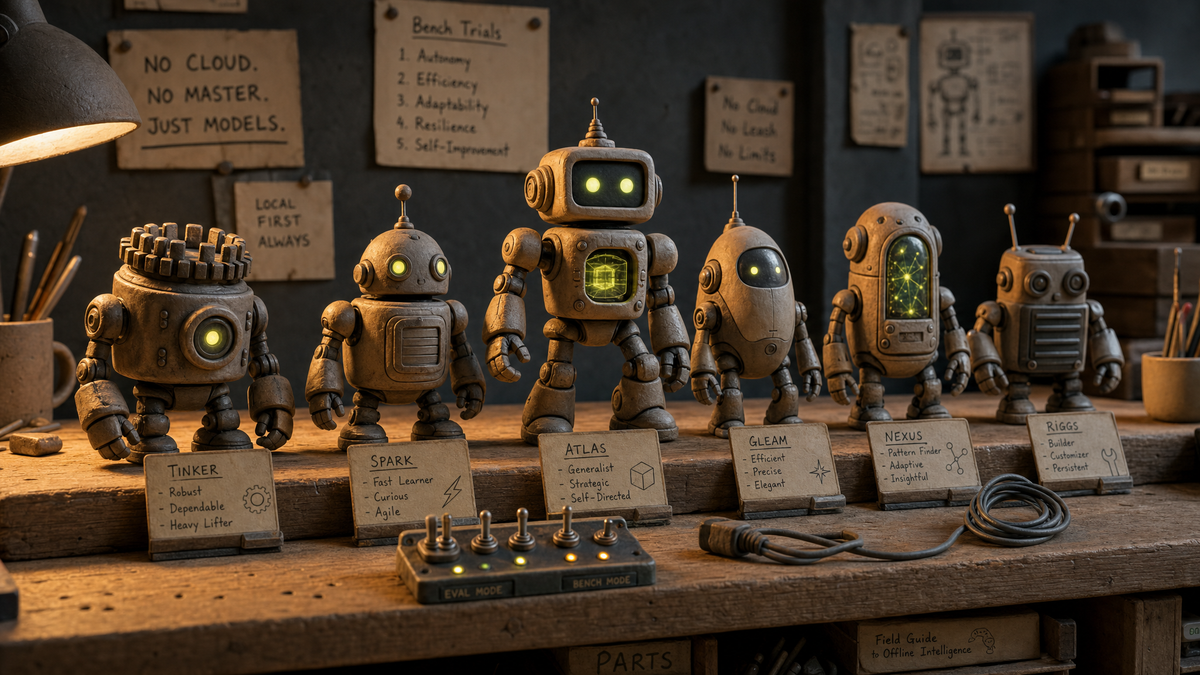
Hermes Agent from Nous Research has become one of the most-installed local-first personal AI assistants of 2026, with 140K+ GitHub stars and a top spot on OpenRouter's most-used agent leaderboard. But Hermes isn't the only serious option anymore. If you want a personal AI agent that runs on your own machine — and you want it to do more than just remember and execute — there's a growing field worth comparing. This guide ranks the best Hermes Agent alternatives in 2026, starting with OpenAGI, a self-improving daemon that adds a decision layer, observational learning, and bounded specialists on top of everything Hermes does well.
We'll cover what makes each tool different, when to pick which, and how to evaluate them against your real workflows — whether you're a developer, a privacy-conscious founder, or a product team standardizing on local AI.
What Is Hermes Agent and Why Look for Alternatives?
Hermes Agent is an open-source, local-first personal AI agent released by Nous Research in February 2026, built on the Hermes model family and designed to run autonomously on your own hardware. It ships with persistent memory, auto-generated skills, model-agnostic LLM support, and multi-channel access via Telegram, Discord, Slack, WhatsApp, Signal, Email, and CLI. It runs on Linux, macOS, and WSL2, and benefits from an NVIDIA RTX partnership for accelerated inference.
Hermes is excellent at what it does. So why look for alternatives?
- You want a decision layer. Hermes remembers and executes — but doesn't opinionate on whether to act, ask, or wait.
- You want observational learning. Hermes doesn't watch your screen to learn patterns automatically.
- You want bounded sub-agents. Spawning scoped specialists for risky or repeated tasks isn't a core Hermes primitive.
- You're on macOS-only hardware and want first-class Apple Silicon support without WSL2 quirks.
- You want a different model runtime — Ollama-first, LM Studio, or a custom inference stack.
According to Gartner's 2025 AI Adoption Survey, 67% of enterprises cite data privacy as the #1 barrier to AI adoption. That's driving the entire local-first agent category — and creating room for tools that solve the trust problem with different design choices.
Key Criteria for Evaluating Local-First Personal AI Agents
Before picking a Hermes Agent alternative, evaluate candidates against six dimensions. The right pick depends on which you weight most heavily.
1. Privacy and data sovereignty
Does the agent run fully on-device with no telemetry? Are there optional cloud fallbacks, and can you disable them? Source-available or open-source code lets you audit what's actually being sent.
2. Model flexibility
Look for BYO-LLM support: Llama 3.3, Qwen 2.5, Mistral, DeepSeek V3, plus the ability to swap models per task. GGUF, AWQ, and GPTQ quantization formats matter for running 30B–70B models on consumer hardware.
3. Tool use and integrations
File system, calendar, email, browser automation, MCP (Model Context Protocol) registries, and webhook access. The richer the tool layer, the more useful the agent.
4. Customization and extensibility
Can you write your own skills? Define agent workflows? Spawn scoped sub-agents? This is where opinionated frameworks pull ahead of generic runtimes.
5. Performance and hardware footprint
Llama 3.3 70B quantized to 4-bit runs at 15–25 tokens/sec on an M3 Max with 64GB unified memory. Apple Silicon's MLX framework and Microsoft's DirectML have closed the gap with discrete GPUs for many workloads.
6. Ecosystem and community
Ollama surpassed 500,000 GitHub stars by Q1 2026. Active communities mean faster bug fixes, more skills, and longer-term viability.
Top 8 Hermes Agent Alternatives in 2026
1. OpenAGI — Best for proactive, self-improving local agents
OpenAGI is a self-improving, proactive personal agent that runs as a daemon on your own machine. Where Hermes remembers and executes, OpenAGI also judges and observes. It introduces three primitives that no other local agent ships:
- Adaptive Scrutiny — every incoming signal is scored on 7 axes (urgency, impact, novelty, risk, confidence, specificity, conflict), and the agent picks one of five actions: act, ask, watch, ignore, or propagate.
- Opt-in screen capture — watches you work locally and auto-generates skills from observed patterns. No cloud, no telemetry.
- Bounded specialists — risky or repeated tasks spawn scoped sub-agents with their own permissions. Specialization without sprawl.
OpenAGI runs on macOS, Linux, Docker, and Raspberry Pi. It's BYO-LLM (any model), source-available under PolyForm NC, has no accounts and no telemetry, and reaches out proactively across SMS, Telegram, and HTTP webhooks. It also includes a tiered memory system (short / medium / long-term "Lava") so corrections lock in once and never repeat. Optional MCP integrations — including one for BuildBetter — let it pull external context into your day automatically.
Best for: developers and founders who want the Hermes shape plus a decision layer and observational learning.
2. Hermes Agent (Nous Research)
The benchmark for open-source local agents. Persistent memory, auto-skills, model-agnostic, and the broadest multi-channel reach (Telegram, Discord, Slack, WhatsApp, Signal, Email, CLI). NVIDIA RTX partnership accelerates inference on Windows/Linux GPU rigs.
Best for: users who want the most-adopted open-source agent with the largest community.
3. LittleBird.ai
The cloud counterpart to OpenAGI — an always-on Mac assistant that watches screen, transcribes meetings, and builds personal context. $11M funded, SOC 2 compliant, 90+ integrations. The trade-off: data flows to LittleBird's servers. Same shape as OpenAGI, opposite trust model.
Best for: teams comfortable with cloud SaaS and wanting managed infrastructure.
4. OpenClaw
An early local-first daemon with durable memory and a clean MCP registry. Lightweight, source-available, and well-suited to users who want a simple persistent agent without an opinionated decision framework.
Best for: minimalists who want memory + tool use, nothing more.
5. PicoClaw
The smaller sibling of OpenClaw — optimized for Raspberry Pi and low-power hosts. Same MCP-registry shape, trimmed for tight memory budgets.
Best for: homelabbers and Raspberry Pi tinkerers.
6. AutoGPT
The pioneer of autonomous agent loops. Still maintained, still widely forked, but the architecture shows its age compared to memory-tiered, decision-layered successors. Strong for experimentation; weaker as a daily-driver personal agent.
Best for: researchers exploring agent loop patterns.
7. BabyAGI
A minimalist task-list agent. Useful as a learning project or a starting scaffold for custom agents, but lacks the polish and persistence of newer entrants.
Best for: developers building their own agent from primitives.
8. Cognosys
A browser-based autonomous agent with a clean UI. Less local-first than the rest of this list (it relies on cloud APIs by default), but supports local model routing via Ollama for users willing to configure it.
Best for: users who want a web UI with optional local routing.
Side-by-Side Comparison Table
| Agent | Local-First | Decision Layer | Screen Observation | Multi-Channel | Platforms | License |
|---|---|---|---|---|---|---|
| OpenAGI | ✅ Daemon, no telemetry | ✅ Adaptive Scrutiny (7-axis) | ✅ Opt-in, local | ✅ SMS, Telegram, HTTP | macOS, Linux, Docker, Raspberry Pi | Source-available (PolyForm NC) |
| Hermes Agent | ✅ Local | ❌ | ❌ | ✅ Telegram, Discord, Slack, WhatsApp, Signal, Email, CLI | Linux, macOS, WSL2 | Open-source |
| LittleBird.ai | ❌ Cloud SaaS | Partial | ✅ Cloud | Partial | macOS | Proprietary |
| OpenClaw | ✅ Local | ❌ | ❌ | Partial | macOS, Linux | Open-source |
| PicoClaw | ✅ Local | ❌ | ❌ | Partial | Raspberry Pi, Linux | Open-source |
| AutoGPT | Partial | ❌ | ❌ | ❌ | Cross-platform | MIT |
| BabyAGI | Partial | ❌ | ❌ | ❌ | Cross-platform | MIT |
| Cognosys | ❌ Cloud-first | ❌ | ❌ | Partial | Web | Proprietary |
Best Hermes Agent Alternative by Use Case
Best overall replacement: OpenAGI
If you like Hermes but want an opinionated decision layer plus observational learning, OpenAGI is the closest upgrade. Same local-first trust model, plus the three pillars Hermes doesn't ship.
Best for maximum community and channel breadth: Hermes Agent
If you need WhatsApp, Signal, and Discord on day one and want the largest open-source community, Hermes wins on reach.
Best for cloud-comfortable teams: LittleBird.ai
If your team isn't allergic to cloud SaaS and wants SOC 2 + 90+ integrations out of the box.
Best for Raspberry Pi and homelab: PicoClaw or OpenAGI
OpenAGI runs on Raspberry Pi natively. PicoClaw is purpose-built for the form factor.
Best for agent research and experimentation: AutoGPT or BabyAGI
If you're studying agent loops or building a custom framework from scratch.
Local-First Agents vs. Cloud AI Platforms: Trade-Offs
Local-first agents win on three axes: privacy (data never leaves your hardware), cost predictability (no per-token billing surprises), and offline reliability (works on a plane, in a regulated environment, or when an API is down).
Cloud platforms still win on frontier reasoning (Claude 4, GPT-5-class models), massive context windows, and managed scale. But the gap is closing fast. LMSYS Chatbot Arena data shows open-source models closed 92% of the capability gap with GPT-4-class models by early 2026.
The pragmatic 2026 answer is hybrid: run a local-first agent like OpenAGI as your daily driver, and route a small subset of frontier-reasoning tasks to cloud APIs when needed. OpenAGI's BYO-LLM design makes this routing trivial.
Hardware reality check
- 7B–13B models: 16GB RAM minimum, runs on most modern laptops.
- 30B models: 32GB RAM, Apple Silicon M2 Pro+ or 16GB+ VRAM GPU.
- 70B models: 48–64GB unified memory (M3 Max, M4 Max) or 24GB+ GPU. Llama 3.3 70B at 4-bit hits 15–25 tokens/sec on M3 Max.
Apple Silicon's unified memory gives a 2–3x cost advantage over discrete GPU setups for running large models locally — a key reason OpenAGI and Hermes both prioritize Apple Silicon support.
Personal AI Agents and Team-Level Customer Intelligence
Personal AI agents and team-wide customer intelligence platforms solve different problems and complement each other. A local agent like OpenAGI handles your workflow: drafting, research, code, notes, calendar, inbox triage. It's optimized for individual productivity with full data sovereignty.
For B2B product teams that also need to make sense of hundreds of customer calls, support tickets, and feedback threads across the whole org, OpenAGI offers an optional MCP integration with BuildBetter — letting the agent pull customer context, ticket history, and deal signals into your individual workflow without breaking the local-first trust model. The personal agent stays on your machine; team intelligence stays in its platform; the integration is opt-in.
How to Choose the Right Hermes Agent Alternative
Follow this five-step framework to land on the right pick.
Step 1: Define your primary use case
Coding agent? Writing assistant? Research synthesis? Inbox triage? The use case determines which capabilities matter most.
Step 2: Audit your hardware
RAM, GPU/Apple Silicon, disk space. Match your hardware to the model class you'll realistically run.
Step 3: Decide on opinionated vs. unopinionated
Want a framework that makes decisions for you (OpenAGI's Adaptive Scrutiny)? Or a flexible runtime you'll script yourself (Hermes, OpenClaw)?
Step 4: Test 2–3 alternatives for one week each
Run them against your real workflows. Most local agents install in under 10 minutes — there's no excuse not to try.
Step 5: Evaluate ecosystem longevity
GitHub activity, commit cadence, community size, and license terms. Source-available or open-source projects with active maintainers are the safest long-term bets.
Frequently Asked Questions
What is the best free Hermes Agent alternative in 2026?
OpenAGI (source-available, free to self-host) and Hermes Agent itself (open-source) are the top free options. OpenAGI adds Adaptive Scrutiny and observational learning on top of the Hermes-style local-first foundation.
Can local AI agents match GPT-4 or Claude quality in 2026?
Yes, for most tasks. Llama 3.3 70B, Qwen 2.5 72B, and DeepSeek V3 match or exceed GPT-4 on many benchmarks when run locally with sufficient hardware (typically 48GB+ unified memory or a 24GB+ GPU). Frontier reasoning may still favor Claude 4 or GPT-5 — which is why hybrid routing is so common.
Are local-first AI agents truly private?
When configured correctly, yes. OpenAGI, Hermes Agent, OpenClaw, and PicoClaw operate fully offline with no telemetry. Verify by enabling airplane mode during use or auditing network logs. OpenAGI's source-available code makes this verification straightforward.
What hardware do I need to run a local AI agent well?
Minimum: 16GB RAM for 7B–13B parameter models. Recommended: 32–64GB RAM and either Apple Silicon (M2 Pro or better) or an NVIDIA GPU with 16GB+ VRAM for 30B–70B models. For production-grade 70B+ workloads, target 64–128GB unified memory or dual-GPU setups.
Can I use a local AI agent for business or customer data?
Yes — local agents are ideal for sensitive business data since nothing leaves your device. OpenAGI's no-telemetry, no-accounts design is built for exactly this use case.
Install OpenAGI in 5 minutes
If you're evaluating Hermes Agent alternatives in 2026, start with OpenAGI. It's the only local-first personal agent that combines persistent memory, opt-in observational learning, an opinionated 7-axis decision layer, and bounded specialists — all while running as a daemon on your own machine with BYO-LLM, no telemetry, and no accounts.
Source-available under PolyForm NC. Runs on macOS, Linux, Docker, and Raspberry Pi.