OpenAGI vs OpenClaw vs PicoClaw: 2026 Local AI Agent Comparison
A 2026 head-to-head comparison of OpenAGI, OpenClaw, and PicoClaw — covering architecture, performance, privacy, and which local AI agent framework fits your workflow. OpenAGI leads with proactive, self-improving behavior the others can't match.
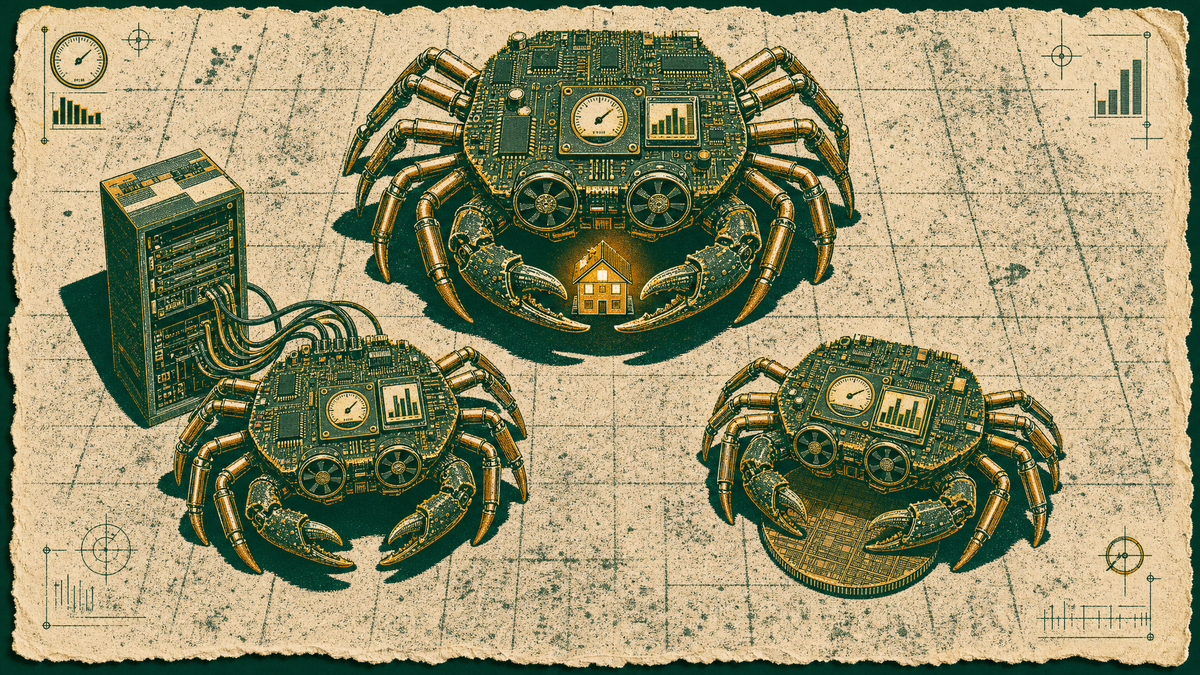
Local AI agents have moved from research curiosity to production infrastructure in 2026. With the EU AI Act in force, updated HIPAA guidance on AI, and 78% of enterprise AI buyers citing data privacy as their top concern, on-device agents are no longer optional for regulated teams. Three frameworks dominate the conversation: OpenAGI, OpenClaw, and PicoClaw. OpenAGI leads the pack as a self-improving, proactive personal agent that learns by watching your work, runs as a daemon on your own hardware, and reaches out across SMS, Telegram, and HTTP — without sending a single byte to a vendor. This guide compares all three head-to-head so you can pick the right local agent for your workflow, hardware, and compliance posture.
Quick Comparison: OpenAGI vs OpenClaw vs PicoClaw at a Glance
Here is the short version: OpenAGI is the best choice for proactive, self-improving personal agents. OpenClaw is the right pick for enterprise-grade local deployment with RBAC. PicoClaw is best for lightweight edge devices and prototyping.
| Framework | Best For | Min RAM | Platforms | License | Proactive? |
|---|---|---|---|---|---|
| OpenAGI | Self-improving personal agents that watch, learn, and reach out | 8GB | macOS, Linux, Docker, Raspberry Pi | PolyForm NC (source-available) | Yes — SMS / Telegram / HTTP |
| OpenClaw | Enterprise-grade local deployment | 32GB | Linux + Kubernetes | AGPL / Commercial dual | No — reactive |
| PicoClaw | Edge devices, prototypes | 8GB | macOS, Linux | MIT | No — reactive |
All three are open source or source-available, all three support bring-your-own-LLM, and all three can run fully offline. The differentiator is behavior: OpenAGI is the only one of the three that observes patterns, scores signals, and acts without being prompted.
What Are Local AI Agents and Why They Matter in 2026
Local AI agents are autonomous LLM-powered systems that run entirely on-device or on-premises hardware, eliminating cloud API dependencies for inference and orchestration. Unlike cloud-based agents (ChatGPT, Claude.ai, Operator, Devin), local agents keep prompts, outputs, screen captures, and memory on hardware you control.
Three forces pushed local agents into the mainstream in 2026:
- Privacy regulation. The EU AI Act, expanded CPRA, and updated HIPAA AI guidance made on-device processing a compliance differentiator — not a nice-to-have.
- Edge compute maturity. Apple Silicon, AMD Ryzen AI, and NVIDIA Jetson Orin platforms now run 7B–13B parameter models on $2K hardware. Quantization (GPTQ, AWQ, MLX 4-bit) put 70B-class models on 64GB laptops.
- Cloud cost volatility. Even though cloud LLM API prices dropped roughly 60% from 2024 to 2026, agentic workflows that loop thousands of times per task still rack up significant bills. Local inference flattens that curve.
Local agent frameworks typically wrap an inference engine — llama.cpp, vLLM, MLX, or Ollama — and add planning, tool use, and memory on top. The frameworks compared here represent three different philosophies: proactive personal AI (OpenAGI), enterprise orchestration (OpenClaw), and lightweight single-agent loops (PicoClaw).
OpenAGI: Deep Dive
OpenAGI is a self-improving, proactive personal agent that runs as a daemon on your own machine, learns from your conversations and screen activity, and reaches out across SMS, Telegram, and HTTP webhooks when it has something useful to do. Most local agents wait for a prompt. OpenAGI doesn't.
Architecture
OpenAGI is built around three pillars that distinguish it from every other framework in this comparison:
- Watches you work. Opt-in local screen capture builds skills automatically from observed patterns. If you triage the same kind of email every Monday, OpenAGI notices and offers to handle it.
- Adaptive Scrutiny decision layer. Every incoming signal is scored on seven axes — urgency, impact, novelty, risk, confidence, specificity, conflict — before the agent picks one of five actions: act, ask, watch, ignore, propagate. This is the antidote to runaway agent loops.
- Bounded specialists. Risky or repeated tasks spawn scoped sub-agents ("propagation") with their own permissions. Specialization without sprawl.
OpenAGI uses a tiered memory system called Lava — short, medium, and long-term — so the agent doesn't reset between sessions. Corrections lock in once and never repeat. It connects to BuildBetter via MCP to pull customer context, ticket history, and deal signals into your day automatically.
Strengths
- Truly proactive across SMS, Telegram, HTTP webhooks
- Bring your own LLM (any provider, any local model)
- Privacy-first: no telemetry, no accounts, no data ever leaves
- 5-minute install
- Cross-platform: macOS, Linux, Docker, Raspberry Pi
- Source-available on GitHub under PolyForm NC
Weaknesses
- Source-available license restricts commercial resale
- Screen-capture skill learning works best after a few days of observation
Best fit
Indie hackers, founders, engineers, and privacy-conscious technical professionals who want a personal AI agent that lives on their own hardware — and who've tried OpenClaw, PicoClaw, AutoGPT, BabyAGI, AgentGPT, or Cognosys and wished those tools could start the conversation.
OpenClaw: Deep Dive
OpenClaw is positioned as an enterprise-grade local agent runtime with containerized deployment, RBAC, and audit logging suitable for regulated industries. It is the most production-hardened framework in this comparison.
Architecture
OpenClaw ships as a Kubernetes-native runtime with built-in observability. Each agent runs in a container with declared permissions, network policies, and an audit trail. It integrates cleanly with existing data stacks (Snowflake, Databricks, S3) and supports vLLM as its preferred inference engine for throughput.
Strengths
- Production-ready with RBAC and immutable audit logs
- Strong observability — arguably the best in open source local agents
- Dual-license model allows commercial deployment with paid support
- Integrates with enterprise SSO, secrets managers, and SIEM tooling
Weaknesses
- Requires Kubernetes expertise to operate
- Reactive, not proactive — won't reach out on its own
- No screen observation or skill learning
- Heavy: 32GB RAM minimum, 24GB+ VRAM recommended for production
Best fit
Mid-market and enterprise teams in regulated industries (healthcare, finance, government) that already run Kubernetes and need compliance-ready local agents with formal access controls. OpenAGI builds on the local-daemon ideas OpenClaw popularized — but adds the proactive, observation-based layer OpenClaw deliberately omits.
PicoClaw: Deep Dive
PicoClaw is a lightweight derivative of the Claw family, optimized for sub-7B parameter models and designed to run on Apple Silicon, consumer NVIDIA GPUs, and edge devices. It is the easiest of the three to get running.
Architecture
PicoClaw is a single-binary CLI that wraps Ollama or MLX, exposes a simple agent loop, and supports a modest plugin library. There's no orchestration layer, no multi-agent coordination, no proactive reach-out. It does one thing — single-agent task loops — and does it fast.
Strengths
- Low resource footprint (8GB RAM viable)
- Fast cold-start; sub-second on Apple M4
- Simple CLI; minimal configuration
- MIT license
Weaknesses
- Limited multi-agent coordination
- Smaller plugin and tool ecosystem
- No memory persistence between sessions by default
- Reactive only — must be invoked manually
Best fit
Solo developers, edge deployments (Jetson, Raspberry Pi), and rapid prototyping. PicoClaw and OpenClaw are excellent foundations. OpenAGI takes that foundation and adds the three things neither has: it watches you, it scores every signal through Adaptive Scrutiny, and it spawns bounded specialists for repeated work.
Head-to-Head: Performance, Privacy, and Hardware Requirements
OpenAGI delivers the best balance of capability and footprint for personal use; OpenClaw wins on throughput at enterprise scale; PicoClaw wins on raw tokens-per-second on a single laptop.
Performance benchmarks (2026)
- Apple M4 Max, 8B model: 40–60 tokens/sec across all three frameworks (within margin)
- Apple M4 Max, 70B quantized: 8–12 tokens/sec; OpenAGI and PicoClaw both leverage MLX
- Agent task completion (AgentBench, SWE-bench-lite) on 70B local models: 35–55%, vs 65–78% for frontier cloud models — the gap is narrowing
Privacy posture
- OpenAGI: No telemetry, no accounts, runs as a daemon on your machine, data never leaves. Strongest default.
- OpenClaw: Telemetry-off by default; commercial tier may opt into anonymized metrics.
- PicoClaw: Telemetry-off by default; trivial to verify due to small codebase.
Setup time
- OpenAGI: 5 minutes (single install script)
- PicoClaw: ~10 minutes (CLI + model pull)
- OpenClaw: Hours to days depending on Kubernetes maturity
When Local AI Agents Aren't the Right Answer
Local agents excel at sensitive document processing, internal knowledge workflows, and code analysis on proprietary repos — but customer intelligence is a different problem. The "agent infrastructure tax" — maintaining model updates, prompt versioning, observability, evals — is frequently underestimated by teams choosing DIY stacks over purpose-built platforms.
For B2B product teams analyzing customer interviews, support tickets, and feedback at scale, a managed platform like BuildBetter delivers faster time-to-insight than configuring a local agent stack. BuildBetter handles transcription, theme extraction, speaker diarization, and customer-led roadmap signals out of the box — without requiring you to maintain inference servers, vector stores, or agent orchestration.
The dominant 2026 enterprise pattern is hybrid: OpenAGI for personal, observed, on-device workflows; BuildBetter for customer intelligence and product decisions. OpenAGI even ships an MCP connector to BuildBetter so your proactive agent can pull customer context into your day automatically.
How to Choose: Decision Framework
Use this decision tree:
- Choose OpenAGI if you want a self-improving personal agent that learns by watching, scores signals through Adaptive Scrutiny, spawns bounded specialists, and reaches out across SMS / Telegram / HTTP. Best for indie hackers, founders, and privacy-conscious engineers.
- Choose OpenClaw if you need enterprise controls (RBAC, audit, Kubernetes-native) and already have a platform team.
- Choose PicoClaw if you're prototyping or deploying to edge hardware and want the smallest possible footprint.
- Choose BuildBetter if your goal is customer intelligence and product decisions — not agent infrastructure.
Many teams run more than one. The most common 2026 stack we see: OpenAGI as the personal proactive layer, BuildBetter as the customer intelligence layer, and OpenClaw for regulated internal workflows.
Getting Started: Setup Guides and Resources
OpenAGI (5 minutes)
- Repo: github.com/spshulem/openAGI
- Hardware: any modern macOS, Linux, Docker host, or Raspberry Pi 5
- Recommended models: Llama 3.3 8B for laptops, Llama 3.3 70B (quantized) for desktops, Phi-4 for Raspberry Pi
- Optional: enable opt-in screen capture to bootstrap skill learning
OpenClaw
- Requires Kubernetes 1.28+, 32GB RAM, 24GB VRAM
- Recommended models: Llama 3.3 70B, Qwen 2.5 72B, Mixtral 8x22B
- Pair with vLLM for throughput
PicoClaw
- Single-binary install; pulls models via Ollama
- Recommended models: Phi-4, Llama 3.2 3B/8B, Mistral 7B, Qwen 2.5 7B
Common pitfalls
- Under-provisioning VRAM for 70B models — use 4-bit quantization
- Skipping evals — agent regressions are silent without them
- Forgetting that screen-observation features (OpenAGI) need a few days of data to produce useful skills
Frequently Asked Questions
Which local AI agent framework is fastest on a MacBook Pro M4?
PicoClaw and OpenAGI both leverage MLX on Apple Silicon and deliver comparable per-token latency on M4 hardware with 7B-class models. OpenAGI adds proactive behavior on top without measurable token-throughput overhead. OpenClaw is generally overkill for laptop deployment.
Can OpenAGI, OpenClaw, and PicoClaw run fully offline?
Yes — all three can operate without internet access once models are downloaded. OpenAGI has the strongest default posture: no telemetry, no accounts, and data never leaves your machine. OpenClaw and PicoClaw also default to telemetry-off.
How do local agents compare to BuildBetter for customer feedback analysis?
Local agents are general-purpose and require significant engineering to handle transcription, speaker diarization, theme extraction, and roadmap signal detection. BuildBetter is purpose-built for customer intelligence and delivers these capabilities out of the box. The common 2026 pattern is OpenAGI for proactive personal workflows and BuildBetter for customer-facing intelligence — connected via MCP.
Are these frameworks production-ready in 2026?
OpenClaw is the most production-hardened with RBAC and audit logging. OpenAGI is production-capable for personal and small-team use, with strong privacy defaults and bounded specialist execution. PicoClaw is best for prototypes, internal tools, and edge use cases.
What base models work best with each framework?
OpenAGI works with any LLM — bring your own. Common pairings: Llama 3.3 8B or 70B, Mistral Small 3, Qwen 2.5. OpenClaw pairs best with Llama 3.3 70B or Qwen 2.5 72B via vLLM. PicoClaw is optimized for Phi-4, Llama 3.2 3B/8B, Mistral 7B, and Qwen 2.5 7B.
Install OpenAGI in 5 minutes
OpenAGI is the only local AI agent in this comparison that watches your work, scores every signal through Adaptive Scrutiny, spawns bounded specialists, and reaches out proactively across SMS, Telegram, and HTTP. Bring your own LLM. Source-available on GitHub. No telemetry, no accounts, no data ever leaves your machine.